
Cryptocurrency
Washington gave crypto every legal win it begged for then lost the market anyway – Crypto News

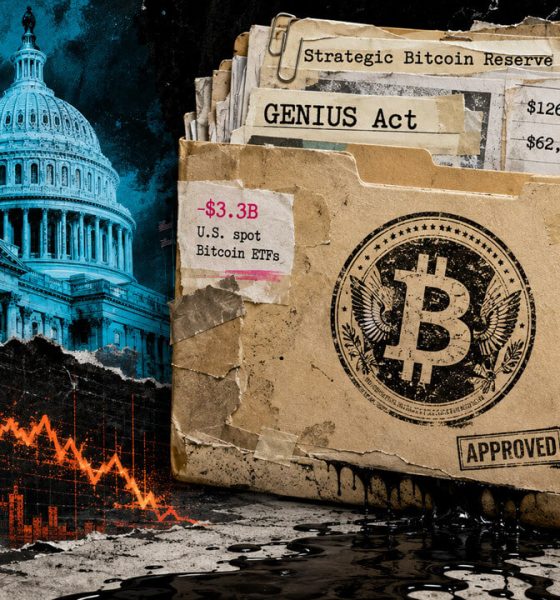
October 6, 2025: Bitcoin breaks above $126,000, carried by the belief that its long migration from internet curiosity to a real financial institution is almost complete. Wall Street has ETFs, public companies are raising billions to buy coins, and the White House wants the US to become the world’s crypto capital. After years of regulatory warfare, institutionalization appears to have arrived.
August 3, 2026: Bitcoin trades around $62,600, a little less than half its peak. In the ten months between those dates, Washington hasn’t revived its old crackdown, closed the ETFs or threatened any of the major American exchanges. It has actually kept moving in the opposite direction, supporting the industry, which left the market without explanation for the decline. The legal barriers the industry faced just a year ago were tough, and many of them fell. However, demand still disappeared. The crypto industry faced many hurdles in the previous cycle. Regulatory uncertainty frightened banks, raised legal bills, discouraged American product launches, and made large institutions reluctant to touch the sector.
Enforcement was done through lawsuits rather than existing laws and regulations; custody was prohibitively expensive, and stablecoins had no federal framework to rely on. A coin could trade for years before the SEC announced that everyone involved had been handling an unregistered security.
A company that doesn’t know whether its core product is legal can’t plan hiring, negotiate banking relationships, or estimate its liabilities with much confidence. Asset managers don’t like explaining novel enforcement risk to investment committees, and banks don’t build products around activities their supervisors may later punish. Coinbase’s 2022 rulemaking petition argued that the existing securities framework couldn’t accommodate much of the digital-asset market, while other executives warned that America was pushing talent, capital, and trading activity overseas.
The rhetoric was often too overheated to produce a concrete solution, but the underlying claim was sound: hostile policy imposed a very high cost on the sector.
From there, industry advocates made a larger assumption. Because unfriendly regulation suppressed activity, friendly regulation would produce more users, more institutional capital, more valuable tokens and higher prices. However, while removing a penalty can make an asset easier to own, it doesn’t create a reason to own more of it.
How Washington slowly changed sides
Donald Trump’s return to office brought the reversal almost immediately. A January 2025 executive order endorsed the lawful use of public blockchains and stablecoins, created a presidential working group, and directed agencies toward a framework built around American digital-asset leadership.
A second order established a Strategic Bitcoin Reserve in March, retaining Bitcoin forfeited to the federal government rather than routinely auctioning it and directing officials to explore budget-neutral acquisition strategies.
CryptoSlate’s policy record shows the scale of the government’s stance reversal. An asset once discussed in Washington mainly through money laundering, sanctions evasion, and consumer harm had become something the United States intended to hold onto. While the change didn’t create an open-market federal buying program, it gave Bitcoin a level of official legitimacy that would’ve sounded implausible a few years earlier.
The SEC also followed with its own set of actions, launching a dedicated crypto task force and dismantling much of the litigation campaign inherited from the prior commission. Its case against Coinbase was dismissed in February 2025, followed by actions involving Kraken, Consensys, Cumberland, Binance, and others. By April 2026, the agency reported that it had dismissed seven crypto-related cases brought under its former leadership.
The first major federal crypto statute actually came from Congress. The GENIUS Act, signed in July 2025, created reserve, licensing, and disclosure requirements for payment stablecoins. The Federal Reserve withdrew special notification requirements for bank crypto activity, and the Office of the Comptroller of the Currency reaffirmed that national banks could provide custody and execution services.
The industry didn’t receive every item on its agenda. The reserve was seeded with forfeited Bitcoin rather than a giant federal purchase, spot ETFs had already been approved in January 2024, and the broader market-structure bill remained unfinished in the Senate as Congress approached its 2026 summer recess.
Even so, crypto now had a friendly executive branch, a less aggressive SEC, federal stablecoin rules, wider banking pathways, and routine access to policymakers. Executives could make product decisions without assuming that every new feature would end in federal court.
Those changes amounted to an enormous political victory, but none required investors to keep buying at six figures.
The Bitcoin market wants and needs actual money
Bitcoin reached its all-time high on October 6, 2025. Four days later, a global risk shock collided with a market carrying far too much leverage, and more than $19 billion in positions were liquidated over roughly 24 hours on October 10 and 11. The global market downturn explains the violence of Bitcoin’s first violent downward swing, but not the weakness that followed over the next nine months.
By July 1, 2026, Citigroup estimated that US spot Bitcoin ETFs had recorded about $3.3 billion of net outflows for the year. The bank reduced its assumption for 2026 ETF inflows from $10 billion to zero and cut its 12-month Bitcoin forecast to $82,000.
While institutional access remained intact, institutional appetite hadn’t.
We saw the same retreat in exchanges as well. Coinbase’s second-quarter filing reported $599.2 million in transaction revenue, down from $764.3 million a year earlier. Monthly transacting users fell from 8.7 million to 7.6 million, and the company recorded a $359.5 million net loss. Coinbase had expanded into stablecoins, derivatives and other businesses while gaining global trading share, so the numbers didn’t amount to corporate collapse; they just showed a strong exchange taking a larger share of a weaker market.
CryptoSlate’s midyear market review placed Bitcoin near $58,600 at the start of July after a 33% annual decline, with June ETF outflows around $4.5 billion.
Spot ETFs were supposed to end Bitcoin’s dependence on offshore exchanges and crypto-native traders, and they largely did. BlackRock, Fidelity, and the rest made exposure available through the same accounts investors use for index funds, bonds, and retirement portfolios, so the inconvenience of wallets, private keys, and specialist custodians disappeared instantly for most buyers.
But that structure also made selling almost frictionless. A wealth manager who once avoided Bitcoin because custody was annoying can now buy it in seconds, then sell it in seconds. Institutionalization put Bitcoin beside every other liquid asset competing for the same capital, and did nothing to produce permanent or even long-term ownership.
That competition for Bitcoin became tougher in 2026 as cash and government bonds continued to offer income, uncertainty around inflation and rates weakened enthusiasm for speculative assets, and capital moved toward artificial intelligence companies. Investors who had already bought Bitcoin through ETFs or corporate proxies didn’t need another policy announcement to validate the position, as many had reached their allocation limits during the rally.
The reservoir of supposedly bottomless institutional capital turned out to be a two-way market: one in which investors wanted to sell as much as they wanted to buy. They could like Bitcoin’s improved legal status and still think that $100,000 was too expensive.
The corporate treasury machine reverses
Digital asset treasury companies were built to provide recurring demand even when ordinary consumers lost interest. A company issued stock, convertible debt, or preferred shares, used the proceeds to buy Bitcoin, and benefited as its equity traded above the value of its holdings. Issuing more shares could then increase Bitcoin per share instead of diluting it, which lifted the stock, improved financing terms, and funded more purchases.
This depended on investors continuing to value the company at a premium to its Bitcoin. Once that premium vanished, new equity issuance diluted shareholders, debt and preferred dividends remained due, and falling Bitcoin prices weakened the asset base that was supporting this entire business model.
Many treasury vehicles began trading below the value of their crypto holdings, making further issuance an unattractive move no one wanted to make.
Strategy, the largest and best-known example, eventually showed how buying could turn into selling. Between June 29 and July 5, 2026, the company sold 3,588 Bitcoin for roughly $216 million to help fund preferred-stock obligations and replenish its dollar reserve. Its SEC filing also disclosed an $8.32 billion second-quarter loss on digital assets, almost all of it an unrealized accounting loss caused by lower Bitcoin prices.
Strategy hadn’t burned through $8.32 billion in cash, and it still held an enormous Bitcoin position.
The sale was important because the entire treasury boom relied on the belief that these companies would absorb supply indefinitely and never become sellers themselves. CryptoSlate’s analysis of the transaction framed it as a test of a model built on years of accumulation.
Washington could permit the strategy, praise it, and imitate part of it through a federal reserve, but it couldn’t suspend corporate finance and stop companies from facing dividend obligations, rising financing costs, and a disappearing equity premium.
What the policy shift achieved
Despite the massive market downturn, falling prices didn’t erase the gains created by friendlier policy. American exchanges are now essentially safe from being litigated out of existence. Banks have firmer authority to offer custody and execution, and stablecoin issuers have a federal framework. Product teams can plan around more predictable enforcement, and companies considering a US launch can assign a lower probability to sudden regulatory attack.
However, most of that value has accrued somewhere other than Bitcoin’s price. The GENIUS Act regulates dollar tokens, payment companies, and Treasury markets without increasing demand for Bitcoin or unrelated crypto assets. Bitcoin holders don’t own claims on stablecoin reserves, issuer revenue, or payment fees.
A dismissed SEC case improves an exchange’s survival odds without improving its product. Bank custody reduces operational risk without forcing an investment committee to raise its allocation. An ETF removes the inconvenience of private keys without making a pension fund ignore volatility. Wider participation from banks and asset managers may also reduce the fees once earned by crypto-native intermediaries.
What policy managed to change is permission, access, and institutional risk. The price decline we saw over the past 10 months showed how often the industry had treated those gains as interchangeable with durable demand and economic use.
Legal permission, institutional access, speculative demand, and everyday use aren’t stages of a single process. An asset can be legal and unwanted, easy to buy and still overpriced, popular with hedge funds and irrelevant to households. A network can move billions of dollars while producing little value for its token, and stablecoins can thrive because people want easy dollars rather than easy crypto.
Bitcoin’s lack of cash flow also makes it less valuable than stocks and other assets to a huge chunk of investors. A stock can eventually support its valuation with earnings, a bond pays interest, and a rental property generates income. Bitcoin depends on future buyers valuing it as scarce digital property, a reserve asset, a macro hedge, or some combination of the three.
Friendly policy strengthens that case by reducing the chance of prohibition and making ownership safer, but it doesn’t settle the price. At $20,000, an allocator may see an asymmetric opportunity. But at $126,000, they may see a crowded position offering no income and substantial downside.
Global liquidity, real interest rates, geopolitical shocks, leverage, and broad risk appetite can overwhelm a favorable SEC announcement. The government can reduce legal uncertainty around an ETF; it can’t make portfolio managers prefer that ETF to cash, gold, bonds or Nvidia.
Crypto’s long fight with Washington offered an external opponent and a sequence of measurable victories: hire lobbyists, fund candidates, win court cases, replace hostile regulators, and pass legislation.
The work ahead isn’t nearly as clear and straightforward as that. Companies have to show that customers use their products when prices aren’t rising, that revenue survives a bear market, that security holds up, and that balance sheets work without perpetual access to overpriced equity.
Asset managers have to show that institutional allocations endure drawdowns rather than arrive after rallies. Bitcoin advocates have to persuade the next buyer without relying on the promise that another government announcement will unlock the market.
Supportive policy didn’t make Bitcoin worthless, and hostile policy wasn’t imaginary. Washington removed a lot of constraints and exposed the ones politicians can’t remove: thin marginal demand, leverage, competition for capital, limited everyday use, and investors who may like the asset at a lower price.
Crypto won the argument over whether it should be allowed inside the American financial system. It now has to prove what it can do there. Washington can permit Bitcoin, regulate it, make it institutionally accessible, and keep some in a federal reserve. It can’t decide what the next buyer will pay.