


others
Canadian Dollar trims back on Crude Oil hesitation with Canada GDP, US Fed rate call in the pipe – Crypto News

- Canadian Dollar trimmed recent gains as energy markets continue to roil.
- Canada absent from economic data docket until Wednesday’s Canadian GDP print.
- Crude Oil pared back recent highs on Red Sea headlines, China growth concerns.
The Canadian Dollar (CAD) eased on Monday, backsliding after Crude Oil markets snipped away the week’s opening highs as the trading week kicks off with a light economic calendar on offer. The midweek period will see an update on Canadian Gross Domestic Product (GDP) and another rate call from the US Federal Reserve (Fed), both slated for Wednesday, and Friday will wrap up the week’s trading action with US Nonfarm Payrolls (NFP).
Canada is expected to see a slight uptick in GDP figures on Wednesday, with November’s MoM GDP forecast to print at 0.1% compared to the flat 0.0% from October, but broad-market focus will be on the Fed’s upcoming rate call and monetary policy statement at 19:00 GMT Wednesday. The Fed will follow up their latest interest rate decision with a press conference at 19:30 GMT.
Daily digest market movers: Canadian Dollar eases on early Crude Oil reversal
- Canadian Dollar down against most of major currencies on Monday.
- Crude Oil markets saw an early high to kick off the trading week, but barrel bids quickly fell back into near-term consolidation, dragging the Loonie lower.
- Iran-backed Houthi rebels in Yemen struck a commercial tanker in the Red Sea over the weekend, and energy markets spiked as retaliation is expected.
- China saw one of its lowest growth periods on record, excluding the Covid pandemic crunch.
- Concerns that the world’s largest Crude Oil importer sees slowing barrel demand is trimming energy bids, capping oil upside.
- Money markets are keen for a rate pivot from the Fed on Wednesday.
- Rate swaps this week are pricing in an 89.5% chance of a Fed rate cut of at least 25 basis points at the Fed’s May meeting, according to CME FedWatch Tool.
- Canada has a thin showing on the economic calendar this week, with Wednesday’s November GDP print and Thursday’s S&P Global Manufacturing Purchasing Managers’ Index (PMI) the only notable lines on the Canadian side.
Canadian Dollar price today
The table below shows the percentage change of Canadian Dollar (CAD) against listed major currencies today. Canadian Dollar was the weakest against the Japanese Yen.
| USD | EUR | GBP | CAD | AUD | JPY | NZD | CHF | |
| USD | 0.26% | 0.07% | -0.08% | -0.24% | -0.37% | -0.28% | -0.10% | |
| EUR | -0.27% | -0.19% | -0.34% | -0.50% | -0.61% | -0.54% | -0.36% | |
| GBP | -0.08% | 0.19% | -0.18% | -0.32% | -0.41% | -0.36% | -0.16% | |
| CAD | 0.09% | 0.34% | 0.16% | -0.15% | -0.25% | -0.18% | 0.00% | |
| AUD | 0.24% | 0.49% | 0.31% | 0.15% | -0.12% | -0.04% | 0.13% | |
| JPY | 0.36% | 0.61% | 0.56% | 0.25% | 0.10% | 0.05% | 0.25% | |
| NZD | 0.28% | 0.54% | 0.35% | 0.18% | 0.03% | -0.08% | 0.19% | |
| CHF | 0.08% | 0.34% | 0.15% | 0.00% | -0.16% | -0.27% | -0.19% |
The heat map shows percentage changes of major currencies against each other. The base currency is picked from the left column, while the quote currency is picked from the top row. For example, if you pick the Euro from the left column and move along the horizontal line to the Japanese Yen, the percentage change displayed in the box will represent EUR (base)/JPY (quote).
Technical Analysis: Canadian Dollar pares back on Monday, chews into recent upswing
The Canadian Dollar (CAD) is broadly lower on Monday, declining against most of its major currency pairs.
The Canadian Dollar is down a quarter of a percent against the Japanese Yen (JPY) and around a fifth of a percent against the New Zealand Kiwi (NZD), while stuck at a scant tenth of a percent gain against the US Dollar (USD) as the Loonie moderates against the broader FX market space.
The USD/CAD pair remains stuck in congestion near 1.3450 as bids get hung up on near-term medians with price action hampered by the 200-hour Simple Moving Average (SMA) near 1.3480.
Daily candlesticks remain stuck closely to the 200-day SMA near 1.3500, and a lack of chart momentum sees a congestion pattern settling into the USD/CAD.
With the 50-SMA drifting into the low side of the long-term 200-day SMA, potential is on the rise for a bearish break toward December’s swing low into the 1.3200 handle.
USD/CAD Hourly Chart
USD/CAD Daily Chart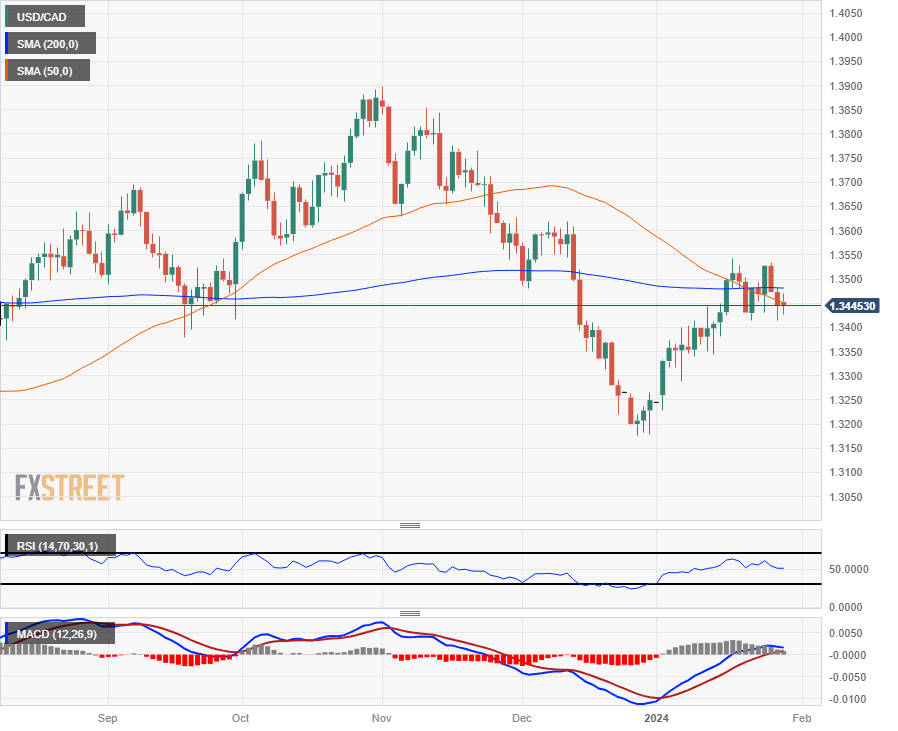
Fed FAQs
Monetary policy in the US is shaped by the Federal Reserve (Fed). The Fed has two mandates: to achieve price stability and foster full employment. Its primary tool to achieve these goals is by adjusting interest rates.
When prices are rising too quickly and inflation is above the Fed’s 2% target, it raises interest rates, increasing borrowing costs throughout the economy. This results in a stronger US Dollar (USD) as it makes the US a more attractive place for international investors to park their money.
When inflation falls below 2% or the Unemployment Rate is too high, the Fed may lower interest rates to encourage borrowing, which weighs on the Greenback.
The Federal Reserve (Fed) holds eight policy meetings a year, where the Federal Open Market Committee (FOMC) assesses economic conditions and makes monetary policy decisions.
The FOMC is attended by twelve Fed officials – the seven members of the Board of Governors, the president of the Federal Reserve Bank of New York, and four of the remaining eleven regional Reserve Bank presidents, who serve one-year terms on a rotating basis.
In extreme situations, the Federal Reserve may resort to a policy named Quantitative Easing (QE). QE is the process by which the Fed substantially increases the flow of credit in a stuck financial system.
It is a non-standard policy measure used during crises or when inflation is extremely low. It was the Fed’s weapon of choice during the Great Financial Crisis in 2008. It involves the Fed printing more Dollars and using them to buy high grade bonds from financial institutions. QE usually weakens the US Dollar.
Quantitative tightening (QT) is the reverse process of QE, whereby the Federal Reserve stops buying bonds from financial institutions and does not reinvest the principal from the bonds it holds maturing, to purchase new bonds. It is usually positive for the value of the US Dollar.









-

 Blockchain1 week ago
The Quantum Clock Is Ticking on Blockchain Security – Crypto News
-

 Metaverse6 days ago
Context engineering and the Future of AI-powered business – Crypto News
-

 Metaverse5 days ago
Stop panicking about AI. Start preparing – Crypto News
-
Metaverse6 days ago
Context engineering and the Future of AI-powered business – Crypto News
-
 Blockchain1 week ago
Tether Launches Dollar-Backed Stablecoin USAT – Crypto News
-

 Metaverse6 days ago
Context engineering and the Future of AI-powered business – Crypto News
-

 Blockchain1 week ago
US Storm Smashes Bitcoin Mining Power, Sending Hash Rates Tumbling – Crypto News
-

 Blockchain1 week ago
Kalshi Expands Political Footprint with DC Office, Democratic Hire – Crypto News
-
Technology1 week ago
Bitcoin And XRP Price Prediction Ahead of FOMC Meeting Tomorrow, Jan 28 – Crypto News
-
Technology1 week ago
Bitcoin And XRP Price Prediction Ahead of FOMC Meeting Tomorrow, Jan 28 – Crypto News
-
Technology1 week ago
Bitcoin And XRP Price Prediction Ahead of FOMC Meeting Tomorrow, Jan 28 – Crypto News
-

 Metaverse1 week ago
Is AI eating up jobs in UK? New report paints bleak picture – Crypto News
-

 others1 week ago
ZetaChain 2.0 Launches With Anuma, Bringing Private Memory and AI Interoperability to Creators – Crypto News
-
others1 week ago
ZetaChain 2.0 Launches With Anuma, Bringing Private Memory and AI Interoperability to Creators – Crypto News
-
others1 week ago
ZetaChain 2.0 Launches With Anuma, Bringing Private Memory and AI Interoperability to Creators – Crypto News
-

 Cryptocurrency1 week ago
Trump family-backed American Bitcoin achieves 116% BTC yield – Crypto News
-

 Cryptocurrency1 week ago
River price defies market downturn, explodes 40% to new ATH – Crypto News
-

 Cryptocurrency1 week ago
Court Crushes Lawsuit Against Ripple – Crypto News
-

 Blockchain14 hours ago
Polymarket Taps Circle to Support Dollar-Denominated Settlements – Crypto News
-
Technology1 week ago
Bitcoin And XRP Price Prediction Ahead of FOMC Meeting Tomorrow, Jan 28 – Crypto News
-
Business1 week ago
Bitcoin Faces Renewed Volatility as Investors Explore Options Like Everlight – Crypto News
-
Business1 week ago
XRP Payments Utility Expands as Ripple Launches Treasury Platform – Crypto News
-

 Technology1 week ago
Elon Musk says ‘WhatsApp is not secure’ amid Meta privacy lawsuit; Sridhar Vembu cites ‘conflict of interest’ – Crypto News
-

 others1 week ago
US Dollar hits 2022 lows as ‘Sell America’ trade intensifies ahead of Fed’s decision – Crypto News
-

 Technology1 week ago
WhatsApp launches ‘Strict Account Settings’: How to enable the new lockdown-style mode? – Crypto News
-

 others1 week ago
Michael Saylor’s Strategy Buys Another $264,100,000 in Bitcoin (BTC) Amid Crypto Market Downturn – Crypto News
-

 Blockchain1 week ago
Crypto Laundering On Centralized Exchanges Declines: Report – Crypto News
-

 others1 week ago
Fundstrat’s Tom Lee Says Earnings Growth, Dollar Weakness Primed To Drive Stocks Higher – Here’s His Target – Crypto News
-

 others1 week ago
QXMP Labs Announces Activation of RWA Liquidity Architecture and $1.1 Trillion On-Chain Asset Registration – Crypto News
-

 Metaverse1 week ago
How to avoid common AI pitfalls in the workplace – Crypto News
-

 Blockchain1 week ago
‘Most Reliable’ Bitcoin Price Signal Hints at a 2026 Bull Run – Crypto News
-
others1 week ago
Breaking: USDT Issuer Tether Launches GENIUS Act-Compliant USAT Stablecoin – Crypto News
-
others1 week ago
Jerome Powell Speech Tomorrow: What to Expect From Fed Meeting for Crypto Market? – Crypto News
-
Business1 week ago
Strategic Bitcoin Reserve: South Dakota Introduces Bill to Invest in BTC as U.S. States Explore Crypto – Crypto News
-
Business1 week ago
Trump’s Crypto Adviser Confirms Probe Into Alleged Theft From U.S. Crypto Reserve – Crypto News
-
Technology1 week ago
WhatsApp launches ‘Strict Account Settings’: How to enable the new lockdown-style mode? – Crypto News
-

 Cryptocurrency1 week ago
Hyperliquid: The frontend wars – Blockworks – Crypto News
-
Technology1 week ago
Solana Price Targets $200 as $152B WisdomTree Joins the Ecosystem – Crypto News
-

 others1 week ago
Crypto Exchange Kraken Announces DeFi-Level Yields for Users in US, EU and Canada – Crypto News
-
Technology3 days ago
Fed Rate Cut Uncertainty Mounts as BLS Delays Jobs Report Amid Shutdown – Crypto News
-
others2 days ago
Crypto Market Bill Set to Progress as Senate Democrats Resume Talks After Markup Delay – Crypto News
-

 Cryptocurrency1 week ago
Hyperliquid explained: The $3 trillion DEX that’s shaking up crypto trading – Crypto News
-
Cryptocurrency1 week ago
Pi Network Price Prediction as 134M Token Unlock in Jan 2026 Could Mark a New All-Time Low – Crypto News
-
Technology1 week ago
Pi Network Price Prediction as 134M Token Unlock in Jan 2026 Could Mark a New All-Time Low – Crypto News
-
Technology1 week ago
Pi Network Price Prediction as 134M Token Unlock in Jan 2026 Could Mark a New All-Time Low – Crypto News
-

 Blockchain1 week ago
BNB Chain’s Prediction Markets Soar As Volume Crosses $20B – Crypto News
-
Technology1 week ago
Trump Speech in Iowa Today: Possible Impact on Stocks and Crypto Market – Crypto News
-

 Blockchain1 week ago
Ethereum Price Breaks Back To $3K As Traders Question Follow-Through – Crypto News
-
others1 week ago
Shiba Inu Price Outlook As SHIB Burn Rate Explodes 2800% in 24 Hours – Crypto News
-

 Technology1 week ago
Microsoft shares slide as AI spending surges – Crypto News