
Cryptocurrency
Hormuz oil contagion spreads to 8 major economies and Bitcoin has just one route through – Crypto News



Bitcoin’s path through 2026 now runs through global economic policy.
The disruption around the Strait of Hormuz has moved beyond a commodity-price event and into the machinery of governments.
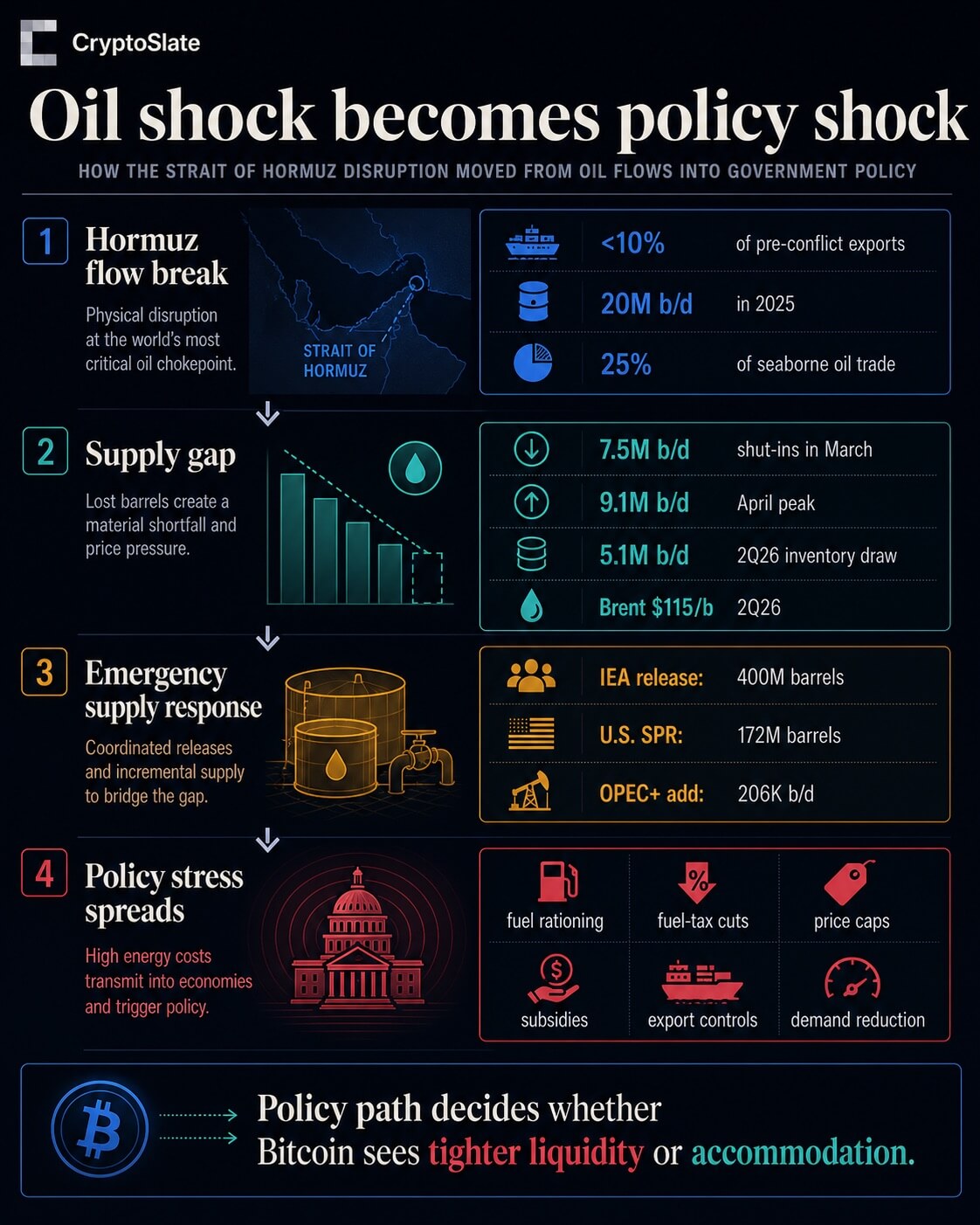
The International Energy Agency said crude and refined-product exports through the strait had fallen to less than 10% of pre-conflict levels after about 20 million barrels per day moved through the route in 2025, equal to roughly a quarter of global seaborne oil trade.
That is the scale of shock that stops being only a Brent chart.
The U.S. Energy Information Administration now expects Middle East production shut-ins to average 7.5 million b/d in March, peak at 9.1 million b/d in April, and drive a 5.1 million b/d global inventory draw in the second quarter. It also sees Brent averaging $115 a barrel in 2Q26 before easing later in the year.
For Bitcoin, the issue is whether markets treat the oil shock as a force that keeps inflation sticky and financial conditions tight, or as a shock severe enough to pull governments and central banks toward more support.
That fork leaves Bitcoin with two defensible pathways into year-end: a stagflation-driven liquidity squeeze that pushes it back into high-beta collateral behavior, or a policy-accommodation trade that lets it reclaim its scarce-asset narrative.

The shock has moved into global economic policy
The policy response is already visible. IEA members agreed to release 400 million barrels from emergency stocks, the largest coordinated release in the agency’s history.
The U.S. Department of Energy said the White House authorized 172 million barrels from the Strategic Petroleum Reserve, with delivery expected to take about 120 days at planned discharge rates.
Supply additions elsewhere do not change the scale problem. Eight OPEC+ members agreed to add 206 thousand b/d in April, a move that may matter at the margin but sits far below the disruption estimates now embedded in EIA’s outlook.
The more important signal is the spread of emergency policy.
The IEA’s 2026 Energy Crisis Policy Response Tracker, updated May 6, lists governments using conservation rules and consumer support to manage fuel stress.
Sri Lanka has introduced QR-based fuel rationing, Korea has odd-even driving restrictions and fuel-price measures, India has LPG and fuel controls, Pakistan has remote-work and public-transport steps, Japan has a subsidy-backed fuel-price cap, Germany has fuel-tax and pricing rules, China has refined-oil price controls, and the UK has heating-oil and industrial support.
The IEA’s separate demand-side report lays out options such as remote work, lower speed limits, public transport, car-access limits, LPG prioritization, and reduced air travel.
Those measures matter for Bitcoin because they shift the oil story from a market-clearing problem to a policy reaction function.
Once governments are cutting taxes, capping prices, rationing fuel, releasing reserves, or subsidizing exposed sectors, the macro signal becomes less clean.
Bitcoin is close enough to the key zone that this macro classification matters immediately. CryptoSlate’s market page showed Bitcoin around $80,794 on May 12, with the broader crypto market near $2.69 trillion and BTC dominance around 60%.
Further, ETF inflows, geopolitical risk, U.S. macro data, Fed signals, and oil stress continue to shape sentiment.
Flows still give the upside case something to work with, but they are not an all-clear signal.
The latest fund-flow report showed $117 million of digital-asset product inflows, a fifth consecutive positive week. Bitcoin products attracted $192 million, while Ethereum products saw $81.6 million of outflows.

The same report noted that four days of outflows were reversed by one strong Friday session, so the flow picture looks resilient but fragile.
That is why the $78,000 to $80,000 area is more than a trading level in this setup. Recent CryptoSlate coverage has tied that band to Bitcoin’s struggle around the Fed, oil-driven inflation pressure, and on-chain supply levels.
If Bitcoin holds it while energy-policy stress stays visible, markets can argue that ETF demand and scarcity narratives are absorbing the macro shock. If it loses the area, the oil shock starts to look less like a debasement trade and more like a real-yield problem.
Two paths now define Bitcoin’s 2026 map
The downside pathway starts with EIA’s oil forecast becoming the macro base case rather than a temporary stress scenario.
Brent at a 2Q26 average of $115, a 5.1 million b/d inventory draw, and multi-million-barrel-per-day shut-ins would keep energy in the inflation conversation even if reserve releases ease the first hit.
Governments can soften the pain with subsidies, tax relief, price caps, direct sector aid, and fuel rules. Those measures can also preserve demand, add fiscal cost, and make it harder for central banks to treat the shock as a clean one-off.
In that version of the year, rate cuts are delayed, real yields stay firm, the dollar remains hard to fight, and Bitcoin trades less like digital scarcity and more like collateral in a risk book.
ETF demand is the transmission channel to watch. CoinShares’ Bitcoin inflow number shows that the bid has not disappeared, but the midweek outflows show how quickly macro caution can drain participation.
If energy inflation keeps Fed expectations tight and ETF flows fade or reverse, Bitcoin does not need a crypto-specific failure to move lower. It only needs the macro backdrop to force de-risking.
Under that pathway, failure to hold $78,000 to $80,000 would make $76,000 to $78,000 the first risk-control zone.
A deeper macro-stress retest would put $70,000 to $73,000 in view. If forced selling and ETF redemptions intensify, the $62,000 to $66,000 area becomes the wider stress band.
These are not stand-alone technical targets; they are the price expression of a market deciding that oil policy is tightening liquidity rather than creating it.

The upside pathway classifies the policy response differently.
In this version, governments absorb enough of the energy shock that growth risk starts to matter more than near-term inflation. Reserve releases, price caps, targeted aid, fuel-tax relief, and demand-reduction measures become a bridge between the shock and eventual policy accommodation.
Markets do not need central banks to ease immediately for that trade to begin. They need real yields to soften, the dollar to stop acting as a wrecking ball, and investors to believe the policy system is moving from inflation restraint toward growth protection.
That is when Bitcoin’s scarce-asset story can return, especially if ETF demand keeps appearing on dips.
The latest CoinShares report does not prove that this path has won, but it keeps it alive. Bitcoin attracted more inflows than the total digital-asset product universe because Ethereum outflows and thinner participation offset BTC demand elsewhere.
That divergence matters. It suggests investors are still willing to isolate Bitcoin as the macro vehicle even when broader crypto participation is uneven.
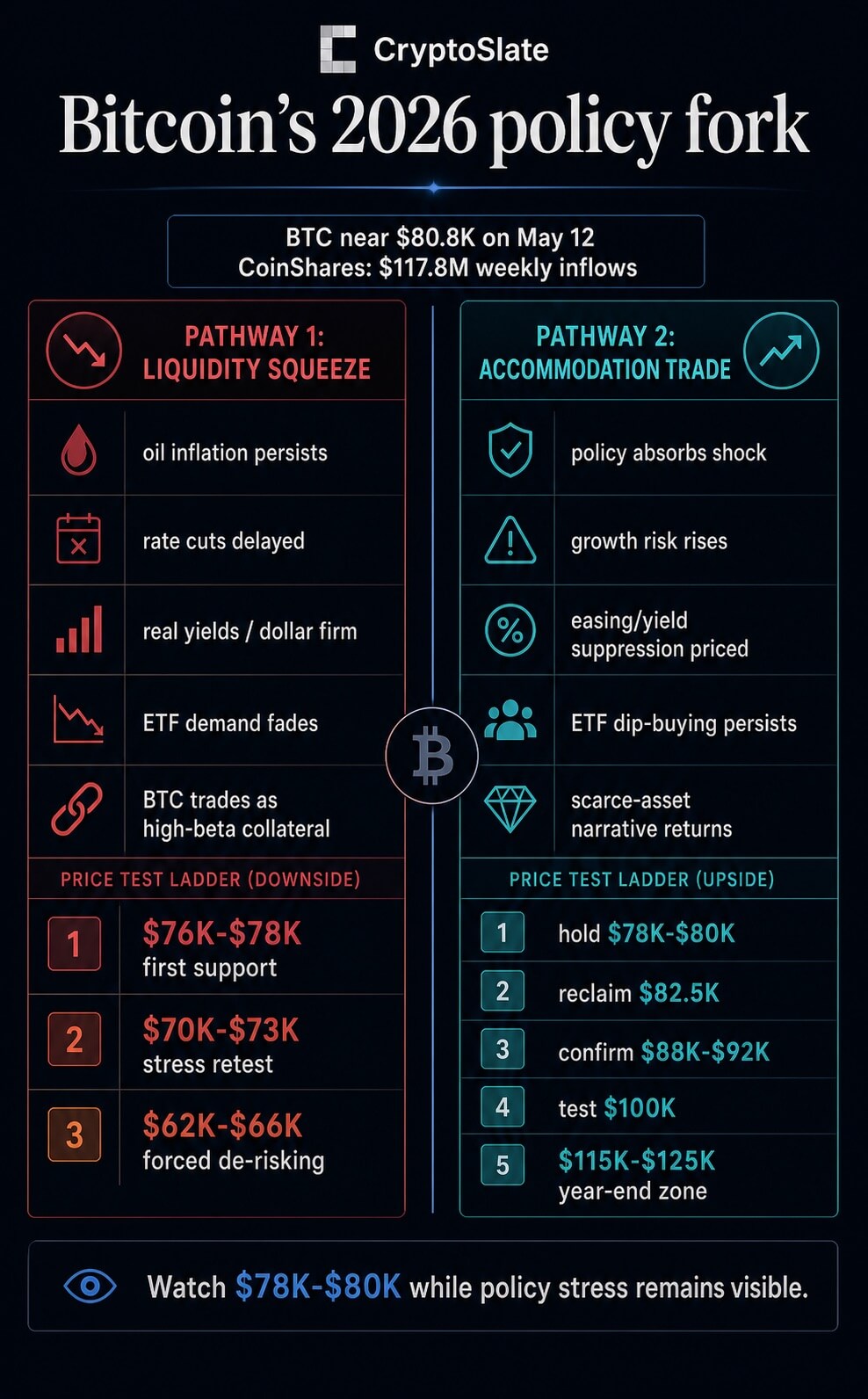
The confirmation ladder is clear. Bitcoin first has to keep $78,000 to $80,000 intact. It then needs to reclaim roughly $82,500, build acceptance through $88,000 to $92,000, and test $100,000.
A move toward $115,000 to $125,000 into year-end requires more than a chart breakout. It would require continued ETF accumulation, softer real-yield pressure, and policy signals that turn energy relief into a broader liquidity expectation.
That is the mirror image of the downside case. The same subsidies, tax cuts, reserve releases, and conservation measures that can keep inflation sticky can also become the first sign that policymakers will not allow the shock to crush demand.
Bitcoin rises if markets decide that policy support is bigger than the inflation drag.
The test is policy, then price
Bitcoin does not need the oil market to return to normal before it can move higher. It needs markets to decide what the policy response means.
If policy keeps consumers spending while energy remains expensive, central banks have less room to ease and Bitcoin remains vulnerable to the high-beta path.
If policy absorbs enough pain to shift the conversation toward growth support, liquidity, and currency debasement, Bitcoin has a route back into the scarce-asset trade.
The live test is therefore simple but demanding. Bitcoin must keep the $78,000 to $80,000 area while oil stress stays visible in government action.
Holding that zone and reclaiming $82,500 would strengthen the accommodation pathway. Losing it would point back to the stagflation squeeze, where oil policy tightens the financial conditions Bitcoin needs to escape.










-

 Blockchain4 days ago
This Week in Stablecoins: TradFi Wants Blockchain – Crypto News
-

 Technology4 days ago
Amazon Exec Predicts Commercial Quantum Computers in 2031 – Crypto News
-

 Blockchain7 days ago
Kaspersky Uncovers Malware Framework Targeting Crypto Investors – Crypto News
-
Blockchain7 days ago
Kaspersky Uncovers Malware Framework Targeting Crypto Investors – Crypto News
-

 Technology3 days ago
Tech Layoffs Hit 2-Year High as Companies Embrace AI – Crypto News
-

 Blockchain1 week ago
Dogecoin Reclaims $0.073 As Meme Traders Look For A Cleaner Rebound – Crypto News
-
Blockchain1 week ago
Dogecoin Reclaims $0.073 As Meme Traders Look For A Cleaner Rebound – Crypto News
-

 Technology1 week ago
Cabinet approves ₹1.9 tn push for chips, mobiles to deepen local manufacturing – Crypto News
-

 others1 week ago
Bybit Wins Excellence in Innovation and Strategic Leadership Awards at Peru Blockchain Conference 2026 – Crypto News
-

 others1 week ago
Numerai Completes Third Strategic NMR Buyback, Bringing Total Repurchases to $3.2 Million – Crypto News
-

 Blockchain5 days ago
Brazilian Securities Watchdog Takes Closer Look at Tokenization – Crypto News
-
Blockchain5 days ago
Brazilian Securities Watchdog Takes Closer Look at Tokenization – Crypto News
-
Blockchain4 days ago
SEC And CFTC Open Joint Consultation On Crypto Derivatives Rules – Crypto News
-
Business1 week ago
Blockchain Association Casts CLARITY Act as Crypto Crime-Fighting Bill – Crypto News
-

 Cryptocurrency1 week ago
Japan passes the crypto law traders wanted but its 20% tax could still wait until 2028 – Crypto News
-
Technology1 week ago
Best Leveraged Prediction Market Platforms for Event Traders – Crypto News
-
others1 week ago
Numerai Completes Third Strategic NMR Buyback, Bringing Total Repurchases to $3.2 Million – Crypto News
-
others1 week ago
US-Iran Update: Oil Prices Surge By 4% as Iran Escalates Fresh Attacks on Gulf Allies – Crypto News
-

 others1 week ago
Meta Faces Lawsuit Over Alleged AI-Driven Mass Layoffs – Crypto News
-

 Blockchain7 days ago
Uniswap Founder Proposes v4 Protocol Fees Across Multiple Networks – Crypto News
-
 Blockchain4 days ago
Wall Street Giants Mobilize Tokenized Assets – Crypto News
-

 Cryptocurrency3 days ago
Galaxy puts $5 million behind Bitcoin’s race to migrate before quantum risk arrives – Crypto News
-
Business1 week ago
Robinhood Chain’s $INDEX 150% Rally Turns Trading Fees Into Real Stock Rewards – Crypto News
-

 Cryptocurrency1 week ago
Bitcoin miner CleanSpark signed a $6.6B AI lease before securing the $2.1B required to build it – Crypto News
-

 Cryptocurrency1 week ago
Bitcoin miner CleanSpark signed a $6.6B AI lease before securing the $2.1B required to build it – Crypto News
-
others1 week ago
$10T Morgan Stanley’s E*TRADE Completes Rollout of Spot Bitcoin, Ethereum, Solana Trading – Crypto News
-

 Blockchain1 week ago
Trump Aide Faces Scrutiny Over $100K in Kalshi Speech Bets: ABC – Crypto News
-

 Blockchain1 week ago
Cardano Tests Support As ADA Traders Look For A Better Catalyst – Crypto News
-

 Blockchain1 week ago
Cardano Tests Support As ADA Traders Look For A Better Catalyst – Crypto News
-

 Blockchain1 week ago
Cardano Tests Support As ADA Traders Look For A Better Catalyst – Crypto News
-
Technology1 week ago
Anthropic IPO: Meta Platforms Eyes $10 Bln Deal With Anthropic As AI Race Heats Up – Crypto News
-

 Blockchain1 week ago
FTX to Distribute $900M to Creditors in Fifth Payment Round – Crypto News
-

 Blockchain1 week ago
Chainlink Holds Support As CCIP Adoption Becomes A Longer-Term Test – Crypto News
-
Blockchain1 week ago
Chainlink Holds Support As CCIP Adoption Becomes A Longer-Term Test – Crypto News
-

 Technology1 week ago
Microsoft trains sales team to talk down OpenAI, Anthropic AI models, pitches itself as ‘full AI platform’: Report – Crypto News
-

 De-fi7 days ago
‘Coinbase Man’ Token Crashes as Armstrong Swaps His Avatar for a CryptoPunk – Crypto News
-

 Technology7 days ago
Is Zepto down? Users hit by mass outage, face disruptions on app and website – Crypto News
-

 Blockchain7 days ago
SEC Approves Higher IBIT Options Limits As Bitcoin ETF Market Matures – Crypto News
-
Technology6 days ago
Pi Network Price Prediction: Can Pi Coin Extend Its Rally Before July Ends? – Crypto News
-

 Technology6 days ago
Instagram, Facebook down? Thousands of users report mass outage; netizens say ‘no posts coming up on feed after refresh’ – Crypto News
-

 Technology5 days ago
Meta Plans Cloud Business to Take on Big Tech Rivals – Crypto News
-

 Cryptocurrency4 days ago
The $1.2 billion options wall came down, and this time Bitcoin actually moved – Crypto News
-
Blockchain4 days ago
SEC And CFTC Open Joint Consultation On Crypto Derivatives Rules – Crypto News
-
Cryptocurrency3 days ago
Galaxy puts $5 million behind Bitcoin’s race to migrate before quantum risk arrives – Crypto News
-

 De-fi1 week ago
Ostium Halts Trading After Oracle Exploit Drains up to $18M from Vault – Crypto News
-

 others1 week ago
Bybit Wins Excellence in Innovation and Strategic Leadership Awards at Peru Blockchain Conference 2026 – Crypto News
-

 Technology1 week ago
Vivo T5 Lite 44W 5G in India with 120Hz display, 6,500mAh battery: Check price and specs – Crypto News
-

 others1 week ago
62,150 Americans Warned After ‘Unauthorized Party’ Breaches Healthcare Firm in Houston – Personal and Health Records Potentially Exposed – Crypto News
-
Business1 week ago
Bitcoin Falls to $63K Lows After Trump Speech & New US Strikes on Iran – Crypto News
-

 Cryptocurrency1 week ago
XRP’s Price Health Is on the Line, Did Shiba Inu (SHIB) Finally Bottom? Ethereum’s (ETH) Mini-Golden Cross: Crypto Market Review – Crypto News