

Cryptocurrency
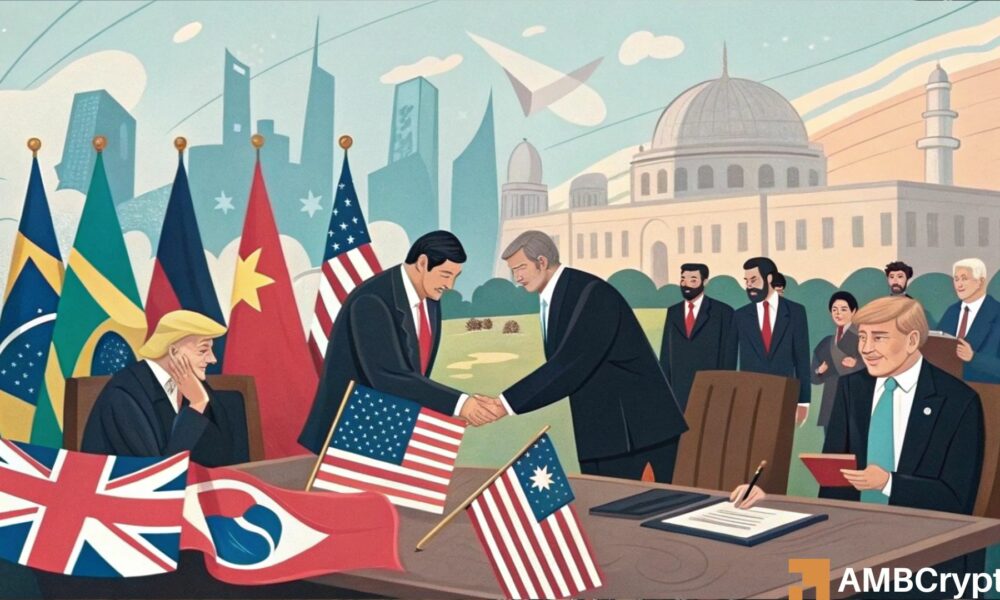
How U.S trade deals could shake up crypto prices! – Crypto News

A nation’s trade policies are powerful weapons in its economic arsenal, and their use has always sent shockwaves through currency markets. Slapping on tariffs or levying sanctions creates a cascade of effects that can jolt a currency’s value.
Now, as global politics get messier and digital money finds its footing, these old-school economic tools are starting to roil the cryptocurrency world.
Old rules – How trade moves money
A country’s trade tactics boil down to a simple game of supply and demand. Any policy that alters how goods and money cross borders will inevitably change how much people want or need a nation’s currency.
When tariffs make imports more expensive, a country naturally buys less from abroad. This cuts the need for foreign currency and can signal a healthier trade balance to investors, often pushing the domestic currency’s value up.
However, it’s never that simple. The other country might retaliate with its own tariffs, hurting exports and reversing any gains. The sheer unpredictability of a trade spat can also spook foreign investors, sending them fleeing and weakening the currency.
Sanctions are a more surgical strike, with complicated results. If sanctions stop a country from exporting its products or freeze its assets abroad, the flow of foreign money dries up, and the local currency usually tanks. However, if sanctions block imports, it can ironically strengthen the local currency because there’s less need to buy foreign cash.
Crypto – New arena for trade fallout
Cryptocurrencies, existing outside of national borders, offer a strange new playground where the effects of trade policy can play out in unexpected ways.
If you’re a country locked out of the global banking system by sanctions, crypto can look like a financial escape hatch. Individuals and even governments might start using digital currencies for international deals, driving up demand for them inside the sanctioned nation.
Citizens watching their life savings get wiped out by a devaluing currency might also dive into crypto. In countries caught in a trade war, people often swap their local money for stablecoins or major players like Bitcoin to shield their wealth from inflation.
The economic wreckage left by trade disputes also has a way of spilling over. If tariffs trigger inflation or slow down a major economy, investors everywhere get nervous. That fear can spread to all kinds of assets, pulling cryptocurrencies down with everything else.
Lessons from previous pacts – What trade deals mean for crypto’s future
Major American trade deals have a long history of redirecting global investment and messing with currency values. By looking at deals like NAFTA, its successor the USMCA, and the rocky trade relationship with China, we can see hints of what’s to come for digital money.
NAFTA/USMCA – Knitting markets together
When NAFTA arrived in 1994, it unleashed a torrent of trade and investment between the U.S., Canada, and Mexico. The USMCA, which took its place in 2020, dragged the agreement into the 21st century with new rules for digital trade and financial services. Crucially, the USMCA included a chapter on currency policies, showing that future trade deals would likely tackle monetary issues head-on.
U.S.-China clash – Live test of economic pressure
The trade fight between Washington and Beijing was a masterclass in how policy can steer money. When the U.S. hit China with tariffs, the dollar briefly strengthened while the yuan weakened. Money fled China, and investors rushed to the dollar as a safe bet.
What does this mean for digital money?
The history of these agreements offers a roadmap for how digital assets like Bitcoin and stablecoins might fit into the global economy.
- Escape from unstable currencies – Just as trade deals now try to stop countries from cheating with their currency, digital assets give people a way out when their government can’t keep its money stable.
- Stablecoins oiling the wheels of trade – Stablecoins, tied to something solid like the U.S. dollar, could make cross-border payments faster, cheaper, and clearer. The USMCA’s embrace of digital commerce paves the way for a future where such currencies are part of the system.
- Dodging government controls – Because digital assets don’t respect borders, they offer a new way to get around capital controls. People and companies could use crypto to shuttle money around the world with greater ease.
- Next “Safe Haven”? The U.S.-China trade war made the dollar look like the ultimate safe asset. But the existence of digital currencies introduces a new challenger for that title.
Is the USD’s reign over? Trade deals and the crypto question
The constant tug-of-war in U.S. trade policy is chipping away at the dollar’s dominance, making room for alternatives like cryptocurrency to get a serious look.
For decades, the U.S dollar has enjoyed the “exorbitant privilege” of being the world’s go-to currency, giving America immense economic and political clout. By late 2024, it still made up nearly 58% of global foreign exchange reserves, with the euro trailing at a distant 20%.
However, that’s a slide from roughly 70% back in the 2000s. The dollar’s lost ground isn’t going to old rivals. Instead, central banks are diversifying into a mix of other currencies, like the Canadian and Australian dollars, or even the Chinese renminbi.
America’s trade policy – A double-edged sword
U.S. trade deals can both help and hurt the dollar. Agreements that open up markets tend to cement the dollar’s top spot. But a swing toward protectionism and tariffs can sow chaos and make the dollar look less reliable.
Worse, using the dollar as a weapon through sanctions has pushed countries like China and Russia to actively build financial systems that don’t depend on America.
Can crypto fill the void?
This cloud of uncertainty around the dollar’s future has opened a debate about what could replace it. Cryptocurrencies, especially Bitcoin, are part of that conversation. Backers say their decentralized design insulates them from the politics of any one country.
However, huge roadblocks remain. They’re too volatile, not always easy to trade in huge amounts, and the rules are a mess. Still, the idea is catching on, and the development of government-backed digital currencies, or CBDCs, could shake things up even more.
Trade pacts – New battleground for crypto rules?
Trade agreements are becoming the main stage for creating universal rules for digital assets. Getting this right could spark wider use, deepen markets, and maybe even calm down the wild price swings.
Right now, the rulebook for crypto is a confusing patchwork. But global groups are trying to get on the same page. The Financial Action Task Force (FATF) has published rules for virtual assets. The European Union’s Markets in Crypto-Assets (MiCA) regulation is a massive step toward creating one set of laws for the entire bloc.
Newer trade deals are going beyond the basics. The World Trade Organization (WTO) has had a temporary ban on digital customs taxes since 1998, but newer Digital Economy Agreements (DEAs) are tackling emerging tech like artificial intelligence.
Standardizing the rules through these massive agreements could change the crypto market in three big ways –
- More people will use it – Clear rules build trust. A predictable legal system would make everyday people and big companies more comfortable jumping in.
- Easier to trade – A single set of rules would make moving crypto across borders much simpler, which means more trading and better liquidity.
- Calmer prices – When trade deals reduce global tensions and promote cooperation, they create a more stable world for investors, which could help tame crypto’s volatility.
Cornered by sanctions, nations and companies gamble on crypto
With trade disputes on the rise, some countries and corporations are looking for new ways to settle international bills, pushing cryptocurrencies toward a central role in a redesigned, decentralized global trade system.
The traditional banking system is now a key tool for enforcing foreign policy. This “weaponization of finance” gives sanctioned countries a powerful reason to find alternatives that sanctioning bodies can’t control. Crypto’s decentralized structure makes it a very attractive option.
Several countries feeling the squeeze of economic sanctions have become pioneers in using crypto for trade –
- Russia – Facing a barrage of Western sanctions, Russia is moving to legalize crypto for international payments. In early 2023, there were reports of Russia and Iran working on a gold-backed stablecoin for their mutual trade.
- Iran – Cut off by U.S. sanctions for decades, Iran has approved crypto payments for imports and has reportedly paid for them with Bitcoin.
- North Korea – The regime is infamous for using hacking and crypto to raise money and get around sanctions.
- Venezuela – To fight a financial “blockade,” Venezuela launched its own state-backed cryptocurrency, the “petro.”
It’s not just nations. Companies are also looking at crypto to protect themselves from trade wars. Stablecoins are especially appealing for managing company funds, promising lower fees and faster transactions.
Crypto miners caught in a geo-political vice
The global supply chain for the powerful computers used in crypto mining has become a front line in the tech war between the United States and China. This has sparked trade policies that are scrambling the entire industry.
Chip war’s collateral damage
The world’s reliance on a handful of East Asian nations for computer chips is a massive weak spot. The U.S has blocked exports of advanced chips to slow down China’s tech ambitions. China, in turn, is pouring money into building its own chip industry.
Squeeze on miners?
For crypto miners, these political games mean real economic pain. Trade policies jack up the price and limit the availability of the specialized hardware they need.
A 25% tariff on mining rigs could eat up 1-2% of a miner’s profits. If those tariffs hit 50-60%, that figure could double, making it nearly impossible for smaller operations to survive.
Threat to the network?
When the hardware supply chain gets clogged, it can slow down the growth of a cryptocurrency’s hashrate—the total computing power securing its network. If new machines are too expensive or hard to get, the network’s security could be at risk.
The line between trade policy and crypto prices isn’t direct, but it’s there. When mining becomes less profitable, miners have to sell more of their newly created coins to cover their costs. That selling puts downward pressure on the cryptocurrency’s price.
Digital currency diplomacy – Governments vs. Crypto
Central banks around the globe are racing to develop their own digital currencies. As of July 2025, 137 countries, accounting for 98% of the world’s economy, are looking into a Central Bank Digital Currency (CBDC). Nearly 50 are already running pilot programs, while the Bahamas, Jamaica, and Nigeria have already launched theirs.
Baking CBDCs into trade agreements could completely change international commerce by cutting out middlemen, slashing fees, and making settlements almost instant.
The emergence of CBDCs sets up a direct rivalry with existing cryptocurrencies. While crypto lets you bypass the banking system, its wild price swings are a major problem for big-league international trade. A CBDC, on the other hand, would have the full backing and stability of a central bank.
Despite the competition, CBDCs and crypto might end up complementing each other. CBDCs could form the new foundation for massive international trade payments, while the nimble nature of existing cryptocurrencies could continue to serve smaller, niche markets.
New economic Cold War?
The U.S.-China trade war is no longer just about tariffs. It has morphed into a deeper strategic rivalry that’s splitting the global economy into two camps.
This conflict, which kicked off in 2018, hit a new level of intensity in 2025. A temporary calm is about to break, threatening a return to punishingly high tariffs. This is forcing a “strategic decoupling” as companies scramble to move their supply chains out of China, with countries like Vietnam and India standing to gain.
This split could create two competing financial worlds. A U.S.-led bloc might favor a system based on transparency, possibly using cryptocurrencies like Bitcoin or a digital dollar with strong privacy features. A China-led bloc, however, would likely rally around a more centralized model, like its own digital yuan.
Mining Costs in the crossfire of trade, green energy
A perfect storm of U.S. trade policy and the global push for clean energy is hammering cryptocurrency miners. Since most specialized mining gear comes from China, the American mining sector is exposed to every twist and turn of the trade war. Tariffs on Chinese products directly inflate the cost of the machines they need to operate.
It’s not just the hardware. Trade policies also mess with energy prices. For example, tariffs on steel and aluminum raise costs for the U.S. oil and gas industry, which in turn can affect the price of power for miners.
At the same time, the pressure to use renewable energy adds another problem. Trade policies can also raise the cost of solar panels and wind turbines, many of which are also hit with tariffs.
A turf war at home?
In the United States, a messy regulatory picture for digital assets is taking shape as the SEC, CFTC, and Treasury Department all fight for control. While they bicker at home, they’re trying to present a united front to the rest of the world.
The core of the domestic fight is whether digital assets are securities or commodities. The SEC claims most are securities, while the CFTC sees them as commodities. The Treasury, meanwhile, is focused on preventing financial crime and keeping the system stable.
Maybe trade deals don’t matter that much to crypto?
There’s a strong argument to be made that U.S. trade deals have little to no real effect on a decentralized asset like cryptocurrency.
Shield of decentralization
Bitcoin runs on a global network that isn’t tied to any single country or government. This design should, in theory, protect it from the specific policies of one nation, like tariffs or sanctions.
Crypto as a political hedge
Instead of being a victim of trade wars, crypto might actually be a refuge from them. Some data suggests that when geopolitical risk is high, Bitcoin has actually delivered better-than-average returns.
It’s all indirect!
While a direct link between a trade deal and the price of Bitcoin is hard to prove, U.S. policy can still stir up the crypto markets indirectly by influencing the general mood of investors. Big trade announcements often cause immediate, wild swings in crypto, as it gets swept up in the broader market reaction.













-

 Technology1 week ago
Embedded Payments Help SaaS as AI Reshapes Workflows – Crypto News
-
others1 week ago
Crypto Market Bill Set to Progress as Senate Democrats Resume Talks After Markup Delay – Crypto News
-

 Blockchain1 week ago
Polymarket Taps Circle to Support Dollar-Denominated Settlements – Crypto News
-

 Cryptocurrency7 days ago
What’s Next for XRP? Ripple Teases Big Updates at This Key Event – Crypto News
-
Technology1 week ago
GLXY Stock Price Falls as Mike Novogratz’s Galaxy Digital Reports $482 Million Q4 Loss – Crypto News
-

 Blockchain1 week ago
Y Combinator Offers Startups Stablecoins Instead of Cash – Crypto News
-
Business1 week ago
Japan’s Metaplanet Pledges to Buy More Bitcoin Even as BTC Price Crashes to $60k – Crypto News
-

 Blockchain1 week ago
Galaxy Digital Reports $482M Net Loss in Q4 2025 – Crypto News
-

 Blockchain1 week ago
Bitcoin Unrealized Losses Reach 22% – Still No Capitulation Phase – Crypto News
-

 Blockchain1 week ago
Solana Eyes Deeper Correction As Bearish Pattern Targets $40 – Crypto News
-
Business1 week ago
Gold vs BTC: Why JPMorgan Suggests Buying Bitcoin Despite Price Crash? – Crypto News
-

 Blockchain1 week ago
Figure Expands Access to Its On-Chain Public Equity Network – Crypto News
-
Business6 days ago
XRP News: Ripple’s RLUSD Gets Boost as CFTC Expands Approved Tokenized Collateral – Crypto News
-

 others1 week ago
Google Agrees To Pay $68,000,000 Settlement To Customers After Being Accused of Listening to Private Conversations on Android Phones – Crypto News
-

 Cryptocurrency1 week ago
Alleged Bitcoin Ransom Note Sent to TMZ in Case Involving ‘Today’ Show Host’s Missing Mother – Crypto News
-
Technology1 week ago
How Low Could Robinhood (HOOD) Stock Go in February? – Crypto News
-

 Technology1 week ago
Indias digital transformation rooted in open, secure, inclusive Internet: IT Secy Krishnan – Crypto News
-

 Cryptocurrency1 week ago
Web 2-Web3 GameFi Platform Playnance Makes First Official Announcement, Reveals Growth Plans – Crypto News
-
Business7 days ago
Bitcoin Price Prediction as Funding Rate Tumbles Ahead of $2.1B Options Expiry – Crypto News
-

 Metaverse6 days ago
Whiteboard your 30-page strategy with Gemini’s nanobanana – Crypto News
-

 Metaverse6 days ago
Whiteboard your 30-page strategy with Gemini’s nanobanana – Crypto News
-
others1 week ago
XRP’s DeFi Utility Expands as Flare Introduces Modular Lending for XRP – Crypto News
-

 Cryptocurrency1 week ago
XRP slides to multi-month lows as liquidations surge amid market rout – Crypto News
-
Technology1 week ago
Kevin Warsh Nomination Hits Roadblock as Democrats Demand Answers on Powell, Cook – Crypto News
-
Business1 week ago
Just-In: Binance Buys Additional 1,315 BTC for SAFU Fund – Crypto News
-

 Cryptocurrency1 week ago
‘We’re in crypto winter’- Bitwise turns bearish as Bitcoin price slips below $75K – Crypto News
-

 Metaverse1 week ago
OpenAI unveils new service, Frontier – How does it work? All you need to know – Crypto News
-

 De-fi7 days ago
ETHZilla to Tokenize $4.7 Million in Manufactured Home Loans on Ethereum Layer 2 – Crypto News
-
Business7 days ago
BlackRock Signals More Selling as $291M in BTC, ETH Hit Coinbase Amid $2.5B Crypto Options Expiry – Crypto News
-

 De-fi6 days ago
Zcash Down Over 50% Since Winklevoss-Backed DAT’s Last Purchase – Crypto News
-

 De-fi6 days ago
Bithumb Mistakenly Airdrops $30 Billion of Bitcoin – Crypto News
-
Cryptocurrency1 week ago
Dogecoin Price Pumps As Investors React to Elon Musk’s DOGE Moon Mission Post – Crypto News
-
others1 week ago
MSTR Stock at Risk? Peter Schiff Predicts Deeper Bitcoin Losses for Strategy Amid Crypto Crash – Crypto News
-

 Technology1 week ago
The AI-Only Social Network Isn’t Plotting Against Us – Crypto News
-
Business1 week ago
Bitcoin Crashes to $67K as Crypto Market Erases $2T in Market Cap Since October Record High – Crypto News
-
Business1 week ago
Is Bhutan Selling Bitcoin? Government Sparks Sell-Off Concerns as BTC Crashes – Crypto News
-
Business1 week ago
Is the Sell-Off Just Starting? BlackRock Bitcoin ETF Sees Records $10B in Notional Volume – Crypto News
-

 Blockchain7 days ago
IREN & CleanSpark Signal Evolution: $SUBBD Solves New Needs – Crypto News
-

 Blockchain7 days ago
Bitcoin Reclaims $71K, But How Long Will It Hold? – Crypto News
-

 Blockchain6 days ago
Binance SAFU Fund Adds 3,600 Bitcoin ($233M) As Market Faces Pressure – Crypto News
-
others6 days ago
United Kingdom CFTC GBP NC Net Positions up to £-13.9K from previous £-16.2K – Crypto News
-

 De-fi5 days ago
Ethereum Falls Below $2,000 as Crypto Sell-Off Deepens – Crypto News
-
Business1 week ago
Is Trump Launching a New Coin? TMTG Teases Token Debut as Traders Turn Bullish – Crypto News
-
Business1 week ago
XRP Price Risks Slide to $1 Amid Slumping XRPL Metrics and Burn Rate – Crypto News
-

 Technology1 week ago
New Firefox settings put AI control back in users’ hands: Here’s how – Crypto News
-

 Blockchain1 week ago
ETH’s Negative Funding Rates May Not Be A Buy Signal This Time – Crypto News
-

 Cryptocurrency1 week ago
Bitcoin prices fall: Will 2026 mirror BTC’s 2022 bear market? – Crypto News
-
Cryptocurrency1 week ago
Bitcoin prices fall: Will 2026 mirror BTC’s 2022 bear market? – Crypto News
-

 Cryptocurrency1 week ago
Crypto Sentiment Sinks to Lowest Level in 3.5 Years – Crypto News
-

 Blockchain7 days ago
Bitcoin Shaken By Major Capitulation Event As Price Drops To $66K – Crypto News