


Metaverse
How WhatsApp is becoming the gateway to a billion Indians – Crypto News

Yadav, already comfortable with UPI, scanned the code, which opened WhatsApp on his phone and presented him with a menu of options. Within minutes, he cleared his dues. Now with WhatsApp’s voice features, he doesn’t even bother with menus. He presses the green mic and says in Bundeli, “Bijli ka bill bharno hai.” An AI bot powered by conversational-AI platform Gupshup replies with a payment link.
Elsewhere, a young mother in a Hindi-speaking town asks a WhatsApp bot what foods are safe during pregnancy. Puch.ai, a WhatsApp-first assistant now available on 9090909090 (one of India’s most expensive numbers as the company spent a fortune to get it), responds in Hinglish with simple diet suggestions as a voice note.
For her, as for 60% of Puch’s users, this is the very first time AI feels like part of daily life.
On another day, an Indian Administrative Service (IAS) aspirant asks Puch for current affairs updates, while a school admin asks for a customized poster for an event.
Similarly for India’s unorganized workers, AI is creeping into their lives through welfare services. A daily-wage worker updating her e-Shram records, India’s national database of unorganized workers that links them to social security benefits. She can now type in her local language in Microsoft’s Jugalbandi bot on WhatsApp and within minutes, can update her details.
These cases may look fragmented at first. A mother here with a diet query, a farmer there finding the best fertilizers through chatbots or a worker elsewhere trying to find welfare schemes. But these strands are tied together by a single, larger narrative: WhatsApp wants to become India’s gateway to AI.
The billion-user challenge
Let’s look at this in reverse order. India has nearly 900 million internet users with a significant majority accessing the internet through their smartphones. Most of these users are outside metros and for them, the internet isn’t a marketplace of apps. It’s mostly a handful of familiar names, such as WhatsApp, YouTube, Facebook and Instagram. Reports show that nearly every user dips into content in her/his native language, and that voice as a medium is also rising steadily.
This means that India’s mass AI adoption is unlikely to be driven by downloads of Perplexity or ChatGPT. For India’s tier I and affluent, English speaking crowd, AI may be a productivity hack or even a therapist; but for the India that resides in non-metros with smaller ticket sizes, and rural India, where the internet is synonymous with WhatsApp or YouTube, AI is likely to enter through the most convenient and intuitive touch points of voice, chat, cues and bots that answer everyday questions in their vernacular.
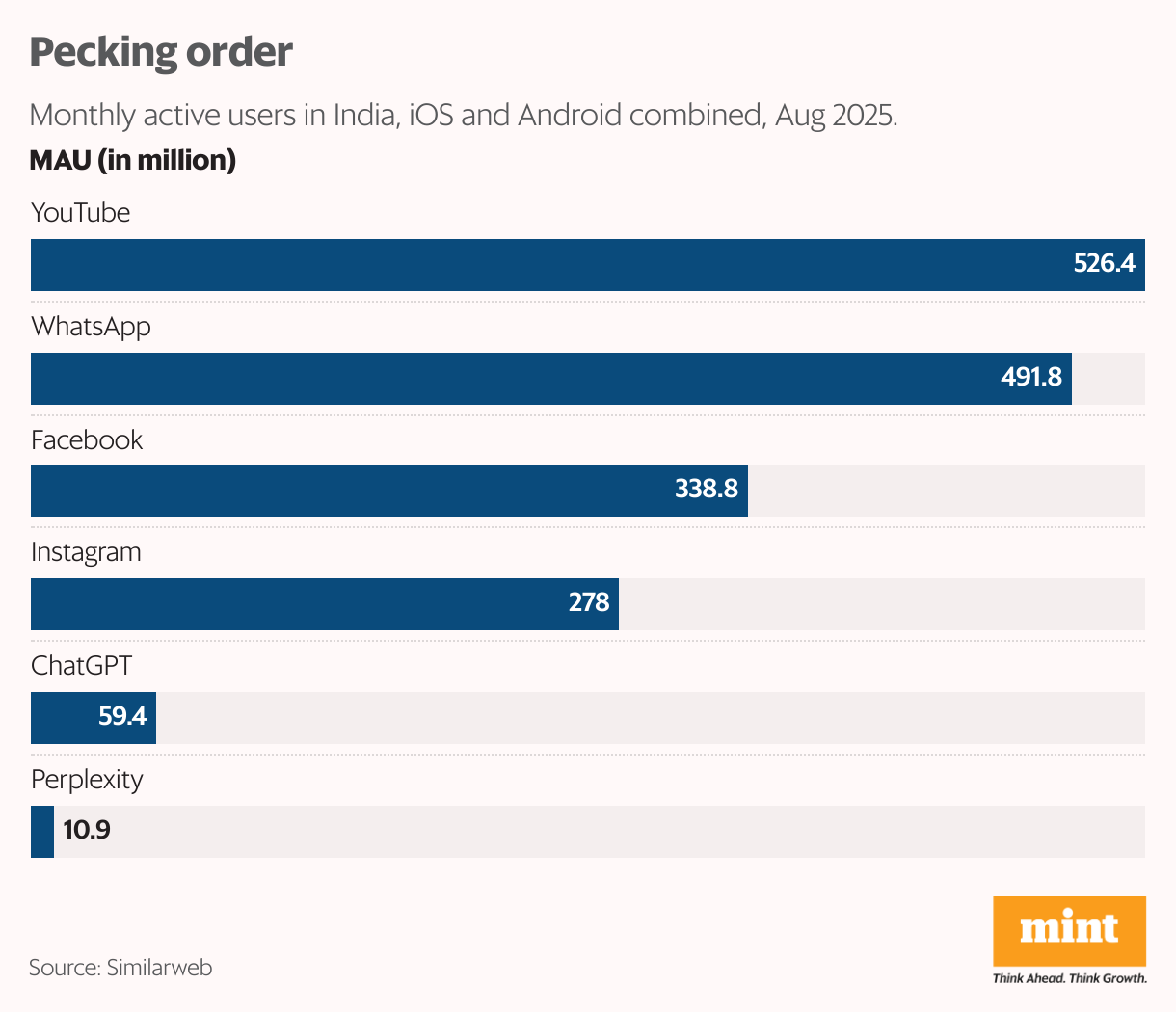
For these users, the easier gateway would be a chat window they already know and use—the one where they exchange politically charged videos, send school notes, and forward endless “good morning” messages.
Acutely aware of the power of its ubiquitous presence in the market, WhatsApp is positioning itself as India’s AI front door. At the centre of this momentum is Sandhya Devanathan, vice president of Meta (WhatsApp’s parent) in India and Southeast Asia. Devanathan, who once navigated the highly cautious and risk-averse corridors of banking, is currently steering one of the fastest moving consumer technology transitions in India.
“If AI lives inside an app you already use every day, like WhatsApp, you don’t need to download, subscribe or learn something new,” she says. “Your usage begins right there.”
Devanathan’s instinct to make technology meet people where they already are is something she has carried across her career. She recalls her early years in the world of banking, where decision making could take months and products were shaped by regulators. At Meta, where she’s spent nearly a decade, she had to learn to follow the exact opposite in terms of speed, experimentation and products that touched consumers directly.
She’s now bringing those two instincts together: the caution of a banker and the urgency of a platform leader. It’s a balance that now defines her role at Meta’s WhatsApp. With India becoming a testbed for how a billion people might access AI and shape habits, Devanathan says WhatsApp has to feel fast and familiar enough to be useful, while also being reliable enough to handle the daily lives of hundreds of millions.
WhatsApp’s AI ambitions can’t be built from glass towers. Last year, Devanathan took her team to a village outside Varanasi, where they watched a mother use Meta AI on WhatsApp to help her child with math homework.
“India has done very, very well there,” Devanathan says of Meta AI’s early adoption on WhatsApp. “What’s been fascinating is people in India don’t always use it the way we imagined from the US. They treat it like a chat, asking questions in their own way. That’s why it’s so important to build with local nuance.”
The shift is visible not just in small and everyday interactions, but also in public services.
“In Andhra Pradesh, for example, 91% of exam hall tickets (admit cards students receive for board exams) were delivered on WhatsApp,” she notes. “What started as a pilot for one metro has now scaled to millions of tickets a month across cities. These are the kinds of everyday conveniences where AI, layered on WhatsApp, can make a real difference.”
To that end Devanathan stresses that WhatsApp’s AI ambitions can’t be built from glass towers. Last year, she took her team to a village outside Varanasi, where they watched a mother use Meta AI on WhatsApp to help her child with math homework, which she says was proof that India’s AI future will be written not in code alone, but in small, everyday moments of need.
The first movers
To be fair, anticipating how first-time users are likely to tap AI is still a code to be cracked even by large tech giants Meta and Google. And while end consumers stumbling onto AI inside WhatsApp through chatbots and conversations feels almost accidental, it is businesses, and to some extent, even governments, that are consciously accelerating this shift.
Businesses benefit from a direct link to consumers without having to do it via an app, whereas government services can largely benefit from the scale that WhatsApp offers. These first movers are teaching Indians to treat WhatsApp not just as a chat app, but as a service desk.
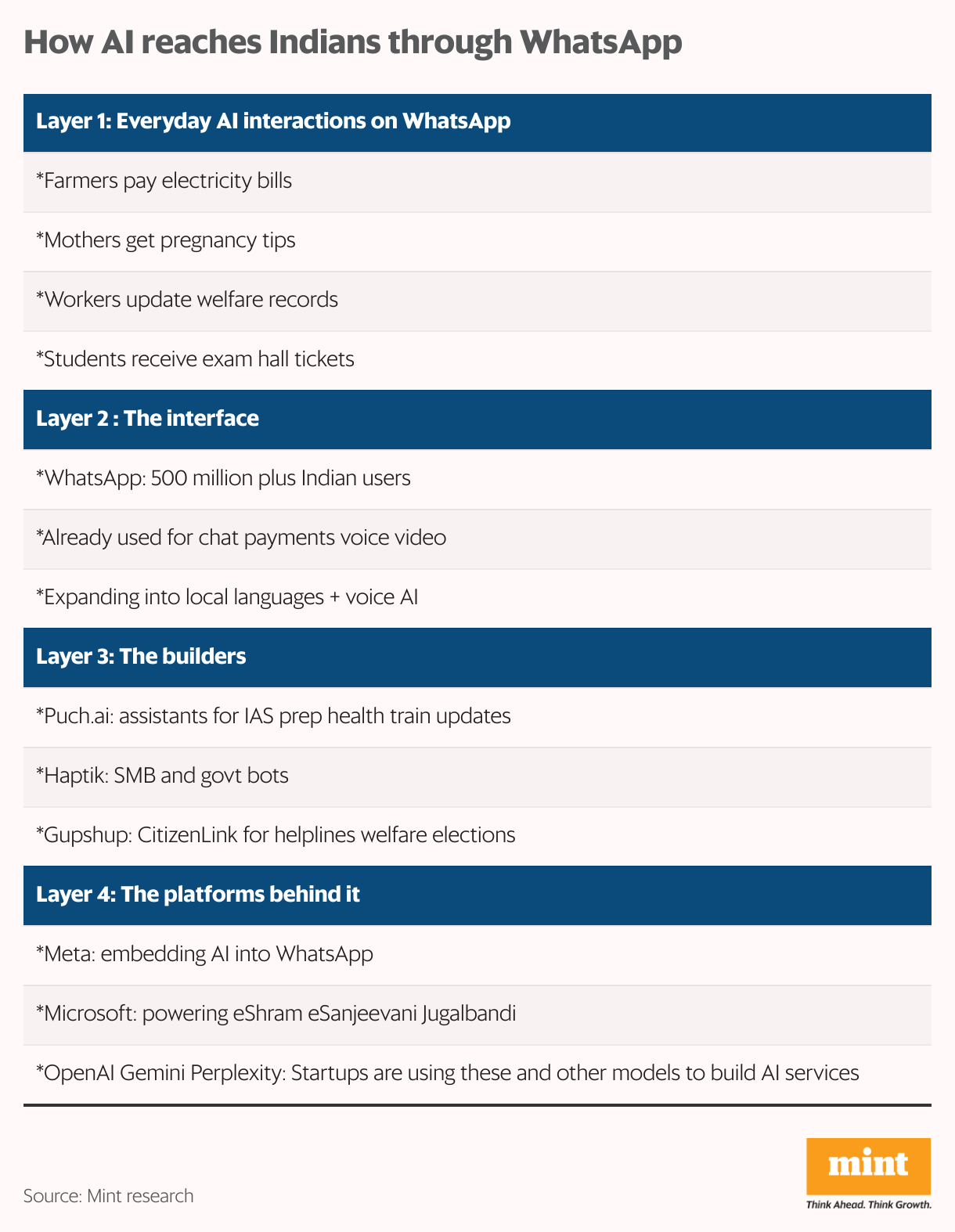
For companies, the appeal is multifold. Conversations on WhatsApp convert far better than interactions on websites or apps.
“The difference is night and day,” says Ahshad Jussawala, CEO of conversational AI platform Haptik. “With standalone apps, there’s friction—downloads, logins, learning curves.” Haptik’s AI assistants allow a user to do everything from booking a doctor’s appointment to tracking an online order, all within a chat.
Jussawala notes that engagement rates on WhatsApp can be five to seven times higher because users don’t have to download them or create logins.

View Full Image
Haptik’s fastest adoption is coming from small and medium-sized business (SMBs) in sectors such as D2C retail, healthcare, education, and logistics. These businesses already use WhatsApp for customer updates but now want those chats to also convert into bookings, payments and lead qualification.
Jussawala says the next step is moving from FAQ bots to “autonomous agents” that go beyond answering questions and can act to complete tasks such as booking tickets, completing transactions and resolving complaints end-to-end.
Government services are also among early adopters of the platform to bypass literacy and access barriers.
Gupshup’s CitizenLink powers everything from electricity bill payments in Madhya Pradesh to complaint redressal helplines and election outreach campaigns.
During the pandemic, when call centres shut down, distribution companies turned to WhatsApp chatbots to keep billing and grievance redressal running. That experience has now expanded into UPI payments, ticket bookings and welfare applications.
Gupshup founder and CEO Beerud Sheth calls this a reversal of the old digital order.
“Instead of expecting people to adapt to apps or websites, we bring the government to familiar channels,” says Sheth. “With Voice AI, a citizen in a remote village who isn’t comfortable typing on a smartphone keyboard can simply speak in the local dialect and receive services instantly,” he says.
This means citizens can check electricity bills, file complaints or even register for a welfare scheme by speaking to WhatsApp in their local language.
Over the next two-three years, Sheth believes these interfaces will evolve from digital assistants to “civic companions” that are proactive systems and can anticipate and address citizen needs before they are even voiced.

View Full Image
For startups such as Puch.ai, WhatsApp has become the gateway to people meeting AI for the very first time, answering IAS prep questions, giving pregnancy diet tips or sharing transport updates.
Puch.ai CEO Siddharth Bhatia says the choice of WhatsApp was strategic. For young Indians in tier II and III towns, downloading and experimenting with ChatGPT is unlikely, but opening a WhatsApp thread is second nature.
“AI reaches them in the same window where they already forward school notes and swap family memes,” he explains. This means users can get exam updates, personalised health suggestions or train status checks in the same platform where they chat with family.
Bhatia argues that this makes WhatsApp a habit-forming bridge—what starts as curiosity in a chat thread can slowly build into a daily relationship with AI.
“To make people benefit from AI, you need to first make it exciting enough for people to try,” he says.
These moves, which demonstrate the varied ways Indians are interacting with AI, show how businesses, governments and startups are converging. They also make clear why WhatsApp has become the most practical bridge between technology and everyday life.
The problem is that this bridge can also become a bottleneck. As more services from bill payments to exam tickets to welfare schemes shift onto WhatsApp, India is anchoring critical citizen interactions to a platform it doesn’t control.
As more services from bill payments to exam tickets to welfare schemes shift onto WhatsApp, India is anchoring critical citizen interactions to a platform it doesn’t control.
This dependency carries risks as policy changes in Menlo Park (Meta’s headquarters) could ripple through Madhya Pradesh’s electricity bills or Andhra Pradesh’s exam halls. Given the geopolitical tension between the world’s superpowers, with tech platforms at the centre of it, the question ringing across policy and tech corridors is: who ultimately decides how AI is delivered to hundreds of millions of Indians?
The sovereignty question
Puch’s Bhatia admits that WhatsApp acts like both the rocket fuel and the restraint.
“We went forward with WhatsApp because, as a nation, we can’t afford to wait to build the perfect interface, and WhatsApp serves as a nice bridge to introduce and get India accustomed to AI,” he says, adding that the company has built its backend to run independently if needed.
The ground reality, however, is very different. Every WhatsApp-first startup depends on Meta’s Business API, whose economics have already shifted several times.
Such changes can directly affect the margins of startups piggybacking on WhatsApp. Startups such as Puch, Haptik and Gupshup are gaining access to millions of users through WhatsApp, which is installed in almost every Indian smartphone. But this kind of reach also comes with the fine print of dependency.

View Full Image
“Dependency is a valid concern, but it’s balanced by the reach and ubiquity of WhatsApp in India,” says Jussawala of Haptik, adding that for most small and medium businesses, WhatsApp is not just another channel—it is the only channel.
At the same time, he acknowledges that the future won’t be WhatsApp alone. He says that businesses are already exploring interoperability to include other chat surfaces, such as Google RCS, Instagram and UPI-linked interfaces.
In its defence, Meta prefers to portray WhatsApp not as a chokepoint but as an enabler. “Our role is to give them the distribution arm that makes it very easy to use. We don’t see a world in which one competes with the other. It’s very complementary,” says Devanathan.
But public deployments also indicate how dependency risks can scale quickly.
While it means speed and ease for citizens as seen with Andhra Pradesh’s pilot with exam hall tickets being sent on WhatsApp or Microsoft’s Jugalbandi bot helping workers update their e-Shram records, for policymakers, it is also a question of total dependence on WhatsApp.
“Governments must design public services so that WhatsApp is one channel, not the only channel,” warns Apar Gupta, lawyer, digital rights advocate, and founder-director of the Internet Freedom Foundation (IFF), a nonprofit that fights for privacy, free speech, net neutrality and accountability in technology policy in India.
Governments must design public services so that WhatsApp is one channel, not the only channel.
— Apar Gupta
“If citizen services exist ‘only on WhatsApp’, public services are ceding control over access, policy shifts, pricing, and product deprecations they do not govern,” says Gupta. He adds that services must be designed to be “platform-neutral”, backed by contractual guarantees of portability and auditability.
If WhatsApp is to become the doorway for AI access for millions of Indians, it also raises the question of how it would affect India’s sovereign AI efforts.
Tanveer Hasan, executive director at the Centre for Internet and Society, is of the opinion that the balance can never be achieved practically. “The state has many other important responsibilities to deliver and cannot realistically match the pace of Big Tech’s R&D,” he says. “The sovereignty question is not always in building new technology, it is in making sure that for technologies with a public infrastructure element, the benefits for people are also hardcoded—not just the ease of doing business or margins for the service provider,” he adds.
These perspectives, when put together, outline the paradox at the heart of WhatsApp’s AI moment. For users it is the easiest way in; for startups it is the fastest way to scale, and for governments it is the path to digitization with the least friction. But as all three converge on this one app, India must decide whether accessibility today is worth the dependency it creates tomorrow.
Key Takeaways
- For users outside India’s urban centres, the easiest way to access AI would be through WhatsApp.
- The app is already used to exchange messages, photos and videos.
- Acutely aware of the power of its ubiquitous presence in the market, WhatsApp is positioning itself as India’s gateway to the world of AI.
- With services from bill payments to welfare schemes depending on WhatsApp, experts warn that India is anchoring critical citizen interactions to a platform it doesn’t control.
- Also, every WhatsApp-first startup depends on Meta’s Business API, whose economics have already shifted several times.
- Such changes can directly affect their margins.















-

 Blockchain1 week ago
The Stablecoin Sandwich Is Missing the Trust Layer – Crypto News
-
others1 week ago
Tom Lee’s BitMine Adds 9,946 ETH, Buys Back 6.1M Shares as Stock Gains – Crypto News
-

 Cryptocurrency1 week ago
Lawsuit claims BitMEX used server freezes and internal trading to seize 622 Bitcoin ahead of its September closure – Crypto News
-

 Blockchain1 week ago
Circle Buys IBM’s Blockchain Patents to Boost Payments Network – Crypto News
-

 Blockchain1 week ago
Kraken Brings CFTC-Regulated Perpetual Futures To US Traders – Crypto News
-

 De-fi1 week ago
Ondo Recasts Its Blockchain as the Ondo Network – Crypto News
-

 Cryptocurrency1 week ago
Compromised owner contract just let hackers print 5.2 million WEMIX stablecoins out of thin air, forcing a complete network freeze – Crypto News
-

 Blockchain1 week ago
Emirates Lets UAE Residents Pay for Flights Through Crypto.com – Crypto News
-

 Blockchain1 week ago
Bitmine Buys More Ether, Bringing Holdings to 5.79M ETH – Crypto News
-

 Cryptocurrency1 week ago
Ethereum price forecast: ETH eyes $2,000 breakout as ETF inflows boost momentum – Crypto News
-

 De-fi1 week ago
Robinhood Chain Tops Solana in Tokenized Stock Volume Via Memecoin Pairs – Crypto News
-
Business1 week ago
Breaking: Grayscale CEO Peter Mintzberg Sells Holdings in GXRP XRP ETF – Crypto News
-

 Blockchain1 week ago
BitMart Faces Withdrawal Complaints Following Wind-Down Announcement – Crypto News
-
De-fi1 week ago
Robinhood Chain Tops Solana in Tokenized Stock Volume Via Memecoin Pairs – Crypto News
-
Technology1 week ago
What Does Bitcoin Really Need? It Needs To Become Money Again. – Crypto News
-
Business1 week ago
Ondo Network Goes Live as Execution Layer for Open Financial Markets – Crypto News
-
Business1 week ago
U.S. CFTC Seeks Expedited Ruling as Minnesota Prediction Market Ban Set to Take Effect – Crypto News
-

 De-fi1 week ago
OCC Denies Wise’s US National Trust Bank Charter – Crypto News
-

 Technology1 week ago
Xbox is down again? Microsoft confirms outage, says ‘We know this has been going on a while…’ – Crypto News
-
Business1 week ago
Breaking: Elon Musk’s Tesla Wins Supreme Court Fight Over 5G Patent Lawsuit – Crypto News
-

 Cryptocurrency1 week ago
Why Hashdex’s new crypto ETF keeps 100% of your initial staking yields and 40% of everything else – Crypto News
-
De-fi1 week ago
Robinhood Chain Tops Solana in Tokenized Stock Volume Via Memecoin Pairs – Crypto News
-
others1 week ago
New York AG Letitia James Warns CLARITY Act Would Limit State Crackdown on Crypto Fraud – Crypto News
-

 Technology1 week ago
Apple wants cheaper OLED displays for iPhone 18 Pro Max amid RAM price surge: Report – Crypto News
-

 Cryptocurrency1 week ago
AI firms are shredding physical books because copyright law is quietly rewarding them – Crypto News
-

 Blockchain6 days ago
US Sanctions Iran-Linked HormuzSafe, Cites Bitcoin Payments – Crypto News
-

 Blockchain6 days ago
Elliptic Report Shows How Bitcoin ATM Scams Move From Cash To On-Chain Wallets – Crypto News
-
Blockchain1 week ago
BitMart Faces Withdrawal Complaints Following Wind-Down Announcement – Crypto News
-

 Technology1 week ago
Poco M8 Power launching in India on 4th August: 8,000mAh battery, AMOLED display confirmed – Crypto News
-

 Cryptocurrency1 week ago
The brutal $346M math behind Galaxy’s high-stakes race to build CoreWeave’s Texas AI mega-center – Crypto News
-

 Cryptocurrency1 week ago
31 newly discovered vulnerabilities expose 99% of x402 crypto payments to asset theft and free shopping – Crypto News
-

 others1 week ago
North Korea Detains Elite State Hackers for Breaching Own Central Banks: Report – Crypto News
-

 others1 week ago
EMCD launches Miner Support Program with up to $30M for miners amid industry’s steepest profitability squeeze – Crypto News
-

 Cryptocurrency7 days ago
Three key demand drivers stall at once, leaving Bitcoin’s $64,000 support to long-term holders – Crypto News
-

 Blockchain1 week ago
Circle Acquires IBM’s Blockchain IP Portfolio – Crypto News
-
De-fi1 week ago
Robinhood Chain Tops Solana in Tokenized Stock Volume Via Memecoin Pairs – Crypto News
-

 Blockchain1 week ago
Binance Phishs Own Staff Monthly, India Censors BitChat: Asia Express – Crypto News
-

 Cryptocurrency1 week ago
Bitcoin’s $65,000 rebound looks like a relief rally, but Wednesday’s Fed decision could turn it into a trap – Crypto News
-

 De-fi1 week ago
Inside the brutal 2-minute flash crash sending a $400M South Korean market plunging on Hyperliquid – Crypto News
-

 Blockchain1 week ago
FIS Links Digital Money to Smarter Bank Networks – Crypto News
-
De-fi1 week ago
Robinhood Chain Tops Solana in Tokenized Stock Volume Via Memecoin Pairs – Crypto News
-
others6 days ago
Pi Network Price Prediction as PI Outperforms Bitcoin Ahead of Ninth Protocol Upgrade – Crypto News
-
Business1 week ago
Binance co-founder Chengpeng Zhao “CZ” Warns Against Crypto Exchange Acquisitions – Crypto News
-

 Cryptocurrency1 week ago
Ethereum outperforms Bitcoin as Bitmine buys 9,946 ETH – Crypto News
-
others1 week ago
NVIDIA Expands Agent Toolkit to Build Quantum-Powered AI Agents amid $250B OpenAI Talks – Crypto News
-

 Cryptocurrency1 week ago
Crypto market records $435M in liquidations as prices hold firm – Crypto News
-
others1 week ago
Crypto Market Brief July 27 – Crypto News
-

 De-fi1 week ago
A $650 million wave of bridge hacks just triggered a $7 billion mass migration to Chainlink – Crypto News
-

 others1 week ago
Scammers Drain $420,000 From Florida and Resident After Posing As Law Enforcement Officers – Crypto News
-

 De-fi1 week ago
Safe Logs 130M Transactions in Q2, a Quarterly Record – Crypto News