Metaverse
human intelligence for artificial minds – Crypto News

Week after week, she opens foetal ultrasound scans on her computer and carefully annotates them to outline organs, measure growth and flag anomalies. Her work is helping train AI systems being developed for hospitals in the US and other western countries. So, when a woman in Dallas undergoes a pregnancy scan, the algorithm guiding the diagnosis may, in part, be shaped by Chandran’s judgment in Kochi.
View Full Image
Chandran is part of a new workforce emerging in India. Once seen as low-cost projects done by anonymous workers labelling cats or stop signs, AI training today has moved to a higher level requiring domain expertise and accountability. Doctors, dentists, linguists and engineers are becoming the ‘human in the loop’ for algorithms, where the penalty for error can be catastrophic.
At the centre of this shift are data annotation firms, which have evolved from volume-driven labelling to expert-led AI training. Globally, companies such as Scale AI and Turing are building human-in-the-loop systems that rely on domain specialists rather than anonymous crowdworkers. iMerit, headquartered in San Jose with major hubs in Kolkata, Bengaluru and Coimbatore, is also embedding doctors, engineers and linguists into critical AI workflows.
Other companies offering expert AI data training include Cogito Tech and Pixel Annotation which have their roots and a large presence in India, reflecting how the country has become a global base for expert-in-the-loop talent powering the AI systems used in hospitals, cars and financial institutions worldwide.
“Expert data is the third pillar of AI,” says Radha Basu, founder and chief executive officer (CEO) of iMerit. “Compute and algorithms are vital, but without precision data, models fail at the last mile.”

View Full Image
iMerit has launched a scholars programme to fill this gap. It is a curated global community of PhDs, MDs, linguists and engineers who question, prompt, coach and debug models across failure points. They act like teachers testing students, says Basu, who has vast experience leading SupportSoft through its NASDAQ IPO, working with HP, and now shaping iMerit.
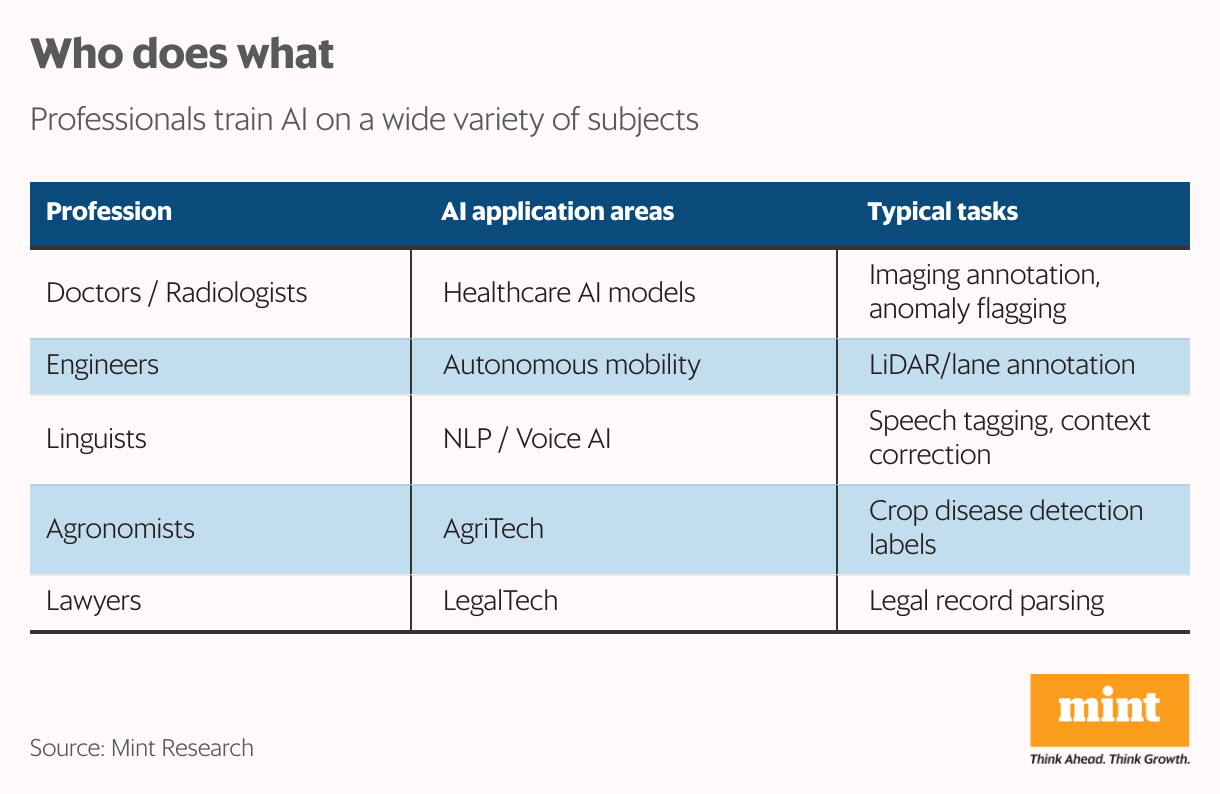
Cogito Tech, headquartered in New York and with its workforce primarily in New Delhi, has taken a similar path. Its clients include healthcare, fintech, agriculture and legal AI companies that require specialist-led annotation, from radiologists and pathologists to lawyers and agronomists. The company’s workforce in India has grown to about 2,500 full-time professionals and a consulting network of 7,000 to 8,000 experts, many of whom contribute part-time while continuing their primary careers. Rohan Agrawal, CEO of Cogito Tech, says the company has roughly 500 experts on payroll training the next layer of AI.
In healthcare, expert AI training means training models with domain specialists who can flag anomalies invisible to a layperson, or assist a radiologist to do the same. In autonomous mobility, it needs engineers capable of interpreting complex data so vehicles don’t misread their environment. Without expert knowledge embedded into these systems, the risks are far too high.
“When we started a decade ago, the job was basic—just drawing boxes around objects in images,” says Siddharth Bal, director of autonomous mobility at iMerit. “Now, the work has become far more complex. Annotators have to make sense of data coming from multiple sensors, spot why a self-driving system failed in a test, or even help train a car to explain its driving decisions.”

View Full Image
Expert in the loop
Aparna Bhasin, a 44-year-old radiologist based in Gurugram, represents a new kind of doctor straddling the world of medicine and machine learning. After spending two decades in clinical practice, she now spends over 70% of her time training AI systems for Cogito Tech, where she serves as clinical division lead.
“Doctors are lifelong learners. We’re supposed to stay on top of everything,” she says, recalling how she found her way into medical AI training roughly five years ago, when the scope of the work was mainly restricted to data labelling, such as for anatomical images.
What began as an experiment has turned into a career shift for Bhasin. “I realised it wasn’t about AI replacing doctors. It’s about helping doctors manage more patients when resources are limited,” she says. “The belief that AI can be an adjunct, not a threat is what keeps me engaged.”
I realised it wasn’t about AI replacing doctors. It’s about helping doctors manage more patients when resources are limited.
—Aparna Bhasin
Bhasin describes her work as teaching a machine to see what a human radiologist sees. Thousands of anonymised scans such as X-rays, CTs and MRIs are studied, cross referenced and labelled by her team.
“We give clinical input based on what we see, how we interpret it and what counts as an anomaly,” Bhasin says, explaining her role. “The engineers then translate that into a language the computer understands. Over time, the model learns: if it sees this white patch, it means something. If it sees this shadow, it means something else.”
Bhasin recalls a project where she helped train an Indian company’s AI tool designed to detect abnormalities in X-rays—from chest scans to bone and abdominal images. “It felt good to know that something I contributed to could help doctors in remote areas and in places where specialists rarely go. Maybe because of this, someone would be diagnosed and referred in time.”
Sushovan Das, another medical scholar with iMerit, calls his pivot from dentistry to data annotation a leap of faith. A graduate of Manipal College of Dental Sciences, Das ran his own dental clinic in Howrah before joining iMerit. “In a clinic you see the same kinds of patients every day, confined within four walls,” he says. “I always wanted to do something out of the box, something futuristic.”

View Full Image
In his current role, Das reads anonymized patient records and organizes them into a clear and structured format that computers can learn from. The role draws on his medical training but does not involve diagnosing or treating patients.
Checks and balances
As doctors in India train global AI systems, the risk of mistakes runs high. Companies such as iMerit and Cogito have various levels of checks and balances in place to ensure that biases and medical errors are caught.
“The same medical dataset may be tagged by three doctors working independently, and then their assessments are compared algorithmically to identify the most accurate outcome,” says Cogito’s Agrawal.
This layered validation prevents regional bias or human error from creeping into models used in hospitals abroad. Despite relying on Indian professionals for 98% of its workforce, Cogito’s quality assurance pipelines ensure that models align with international medical standards before delivery.
“Security is a hot-button topic,” says iMerit’s Basu, adding that the company codesigns standards with clients and builds repeatable frameworks.
Digital ethics researcher Sundar Narayanan notes that while Indian expertise strengthens global AI, it can also introduce regional biases in fields such as medicine and linguistics. He advises distinguishing universal from local knowledge, using consent frameworks and conducting regular audits to check for bias, rather than excluding Indian experts.
From clickwork to expertise
Founded in 2012, iMerit has grown from basic image labelling to high-stakes AI training in healthcare, mobility and finance. The company employs over 6,000 specialists serving 80 global clients. Cogito Tech’s 2,500 full-time staff and army of consultants train AI for the healthcare, legal and financial sectors.
Across the world, annotation firms and AI startups are formalizing expert-driven pipelines to meet the rising demand for AI adaptation. US-based Scale AI, known for high-volume labelling, is shifting into high-value AI services and has a roster of healthcare clients. Turing, a provider of expert-in-the-loop services, nearly tripled its annual revenue run-rate to about $300 million in 2024 as it expanded its domain-trained workforce.
Across the world, annotation firms and AI startups are formalizing expert-driven pipelines to meet the rising demand for AI adaptation.
“While the US remains our largest contributor base, we also see complementary participation from global regions with strong technical expertise, including India,” a Scale representative told Mint.
For iMerit, the Scholars programme is a rapidly growing vertical. Basu says it is expected to account for 25% of iMerit’s revenue by next year, with repeat use cases such as Ambient Scribe (AI that generates clinical notes from doctor-patient interactions) now gaining significant traction.
Bhasin says that beyond radiology or pathology skills, annotators must be willing to think in a way that machines understand. “Sometimes you have to adapt your clinical judgment…see things through the lens of algorithmic constraints,” she adds.
Unlike crowd platforms for data labelling, where freelancers hunt for microtasks, companies such as iMerit and Cogito source, vet and manage experts directly. Their workflows include various peer and expert review systems, where one expert produces and another verifies.
“We don’t just look for subject knowledge,” Basu says. “We have a whole rubric of meta-cognitive skills—curiosity, creativity, problem solving, even cultural empathy. For one project, we interviewed 100 PhD mathematicians but hired only 30. The others had the math but not the hacker mindset to torment models until they fail.”
This structure is essential in regulated industries such as healthcare, autonomous mobility and finance. Today, about 60% of iMerit’s revenue comes from clients in autonomous mobility—companies building self-driving cars and robotaxis.
Healthcare is also a fast-growing vertical. The company’s healthcare teams also help train generative AI models to produce structured clinical notes, an area where only trained doctors and nurses can bring in the kind of accuracy needed.
Bound by non-disclosure agreements with its clients, iMerit did not reveal the direct consumers of these AI systems, but on its website, it lists clients such as GE Healthcare, Johnson & Johnson, Microsoft and Verbal, a US health-tech startup.
“Healthcare is our fastest-growing and largest vertical,” says Cogito Tech’s Agrawal, adding that the company also supports projects in financial compliance, legal AI and agritech, where agronomists and plant pathologists annotate crop images to detect disease.

View Full Image
Around 80% of Cogito’s clients are based in the US, but Agrawal says the Middle East and Europe are emerging growth markets as more regulated sectors seek expert verified training data. The company counts Siemens Healthineers, Unilever and OpenAI among its clients.
India’s AI training market
For India’s highly trained but under-utilized professionals, this marks a new chapter in the outsourcing journey, where expertise and not just scale or cost advantage is the country’s export.
According to a Data Annotation Report published by software services lobby Nasscom in February 2021, India’s data annotation and labelling market was valued at around $250 million in FY20, with nearly 60% of revenue derived from US clients. Since then, the market has significantly accelerated.
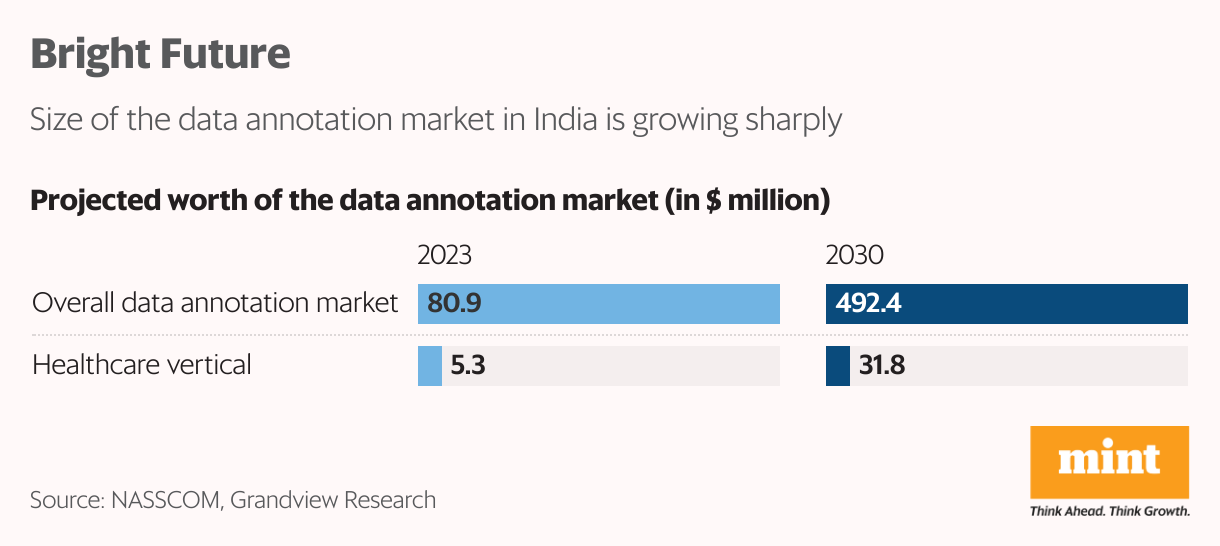
Analyst forecasts suggest that Indian data annotation tools—software platforms used to label and manage datasets for AI model training—were valued at $80.9 million in 2023 and could reach $492.4 million by 2030. Also, healthcare is one of the fastest-growing verticals, projected to go from $5.3 million in 2023 to $31.8 million by 2030.
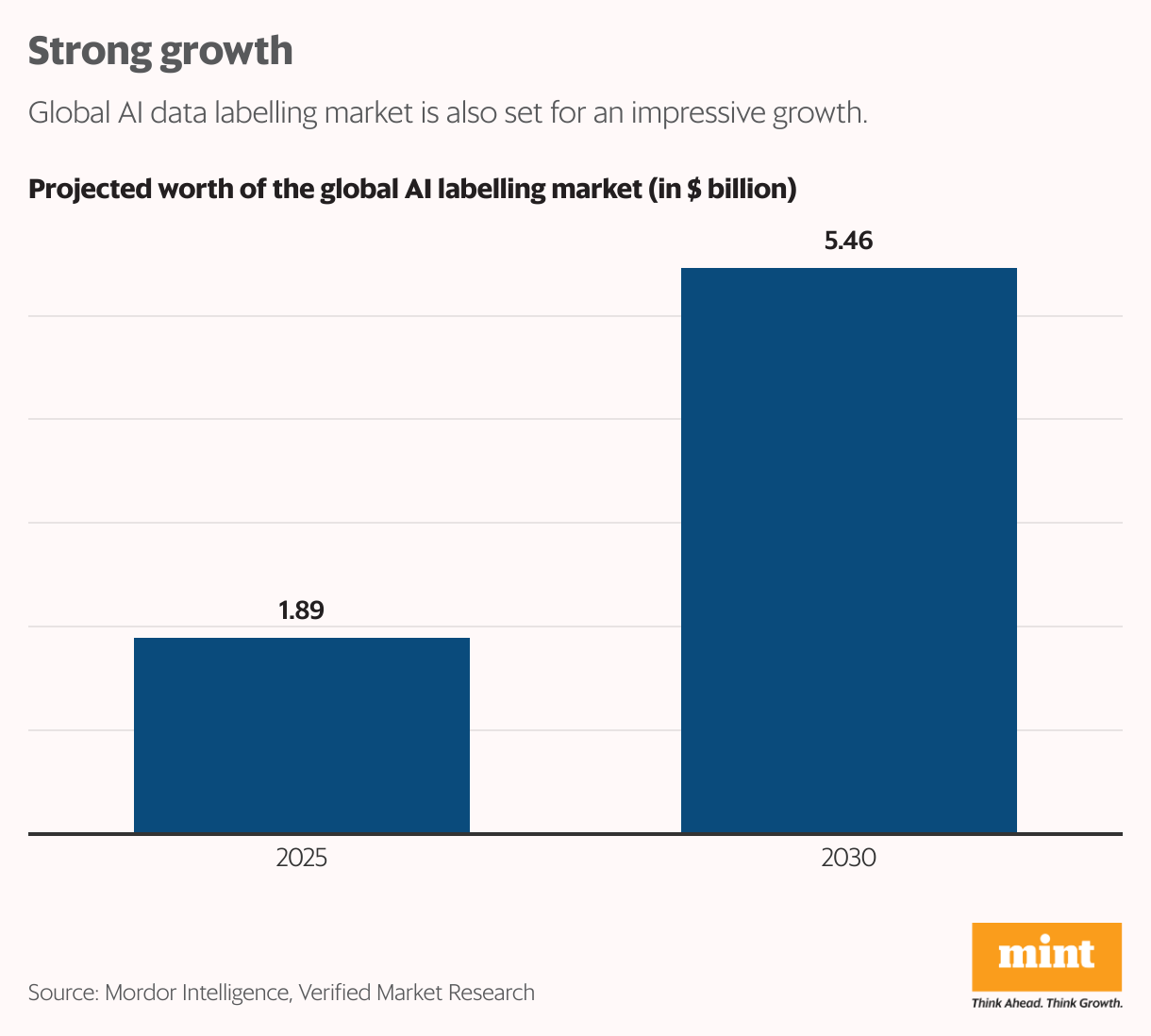
Globally, the AI data labelling market was estimated to be worth $1.89 billion in 2025 and is forecast to grow to $5.46 billion by 2030.
This demand is also visible in recruitment across India. A quick search on the LinkedIn job portal shows 600 ‘data annotation’ roles currently open across India. Some companies now advertise pay of ₹1.5–2.5 lakh per month for full-time specialists in clinical annotation or ₹900-1,500 per hour for part-time work, way above the rates of the annotation economy.
While expert led AI training has moved beyond low-cost data labelling, pay differentials still exist across markets. Cogito Tech’s Agrawal says that Indian specialists typically earn a 10-15% premium over their clinical or professional income when they work on AI projects, but overall compensation remains roughly one-third to half of US rates for comparable expertise. He says the cost advantage along with India’s medical and technical credibility, continue to make it a preferred destination for global AI training work.
“India’s ability to scale specialized talent makes it uniquely positioned to support expert-in-the-loop AI development across sectors,” says Prashanth Kaddi, partner at Deloitte India.
The future
Companies building these capabilities have a vantage point of seeing this evolution from the frontlines.
“The stakes have gone from ‘can we annotate an image?’ to ‘can we help a car see clearly in the rain, or a model flag a tumour reliably in a scan?’” Basu says. “That evolution excites me.”
Agrawal believes this shift represents a new chapter in India’s outsourcing story. “Traditional IT services were about code. This wave is about cognition,” he says. “AI has created jobs that didn’t exist a few years ago. We’ve hired and trained over 11,000 people since 2018.”
This evolution now extends to doctors, radiologists, engineers and linguists, where the new export is not just software but expert judgment.
Having spent five years training models, Bhasin believes the human-in-the-loop requirement isn’t going away anytime soon. “Earlier, we were teaching AI to recognize body parts: this is the liver, this is the brain. Now, we are teaching it to reason through complex cases,” she says. “You may have trained the players how to play the game, but the coach is still needed. Every time the model gets better, our job just moves to a higher level of difficulty.”
Key Takeaways
- Data annotation firms are roping in experts to help train AI models.
- Companies are building systems that rely on domain specialists rather than crowdworkers.
- India has become a global base for expert talent powering the AI systems used in hospitals and cars.
- The cost advantage and professional credibility have made India a preferred destination.
- Specialists typically make 10-15% more on AI projects over their clinical or professional income.
- Analyst value Indian data annotation tools at $80.9 million in 2023 and could reach $492.4 million by 2030.
- Healthcare is one of the fastest-growing verticals, projected to go from $5.3 million in 2023 to $31.8 million by 2030.
- Globally, the AI data labelling market was estimated to be worth $1.89 billion in 2025.
- It is forecast to grow to $5.46 billion by 2030.