


Cryptocurrency
Taiwan’s new crypto law gives banks the first real stablecoin advantage – Crypto News

Taiwan has moved stablecoin issuance into a licensing test for supervised financial infrastructure.
The Legislative Yuan passed the Virtual Asset Service Act on its third reading on June 30, establishing a dedicated framework for crypto trading platforms, stablecoin issuers, and other virtual asset service providers.
The practical consequence is a stablecoin market where approval, reserves, domestic custody, audits, and no-yield limits determine who can scale before open-market crypto issuers have much room to compete.
Under the new framework, stablecoin issuers must maintain full reserve backing, hold segregated reserve assets in trust through domestic financial institutions, undergo regular audits and avoid paying interest or other returns to holders.
Those requirements shift the competitive question from who can launch a token fastest to who can satisfy approval, reserve, custody and disclosure obligations at institutional scale.
That makes Taiwan’s stablecoin market a race with a supervised starting line. The early advantage appears to sit with banks, trust providers, auditors, custody platforms and compliance-heavy virtual asset firms that can connect crypto rails to supervised domestic finance.

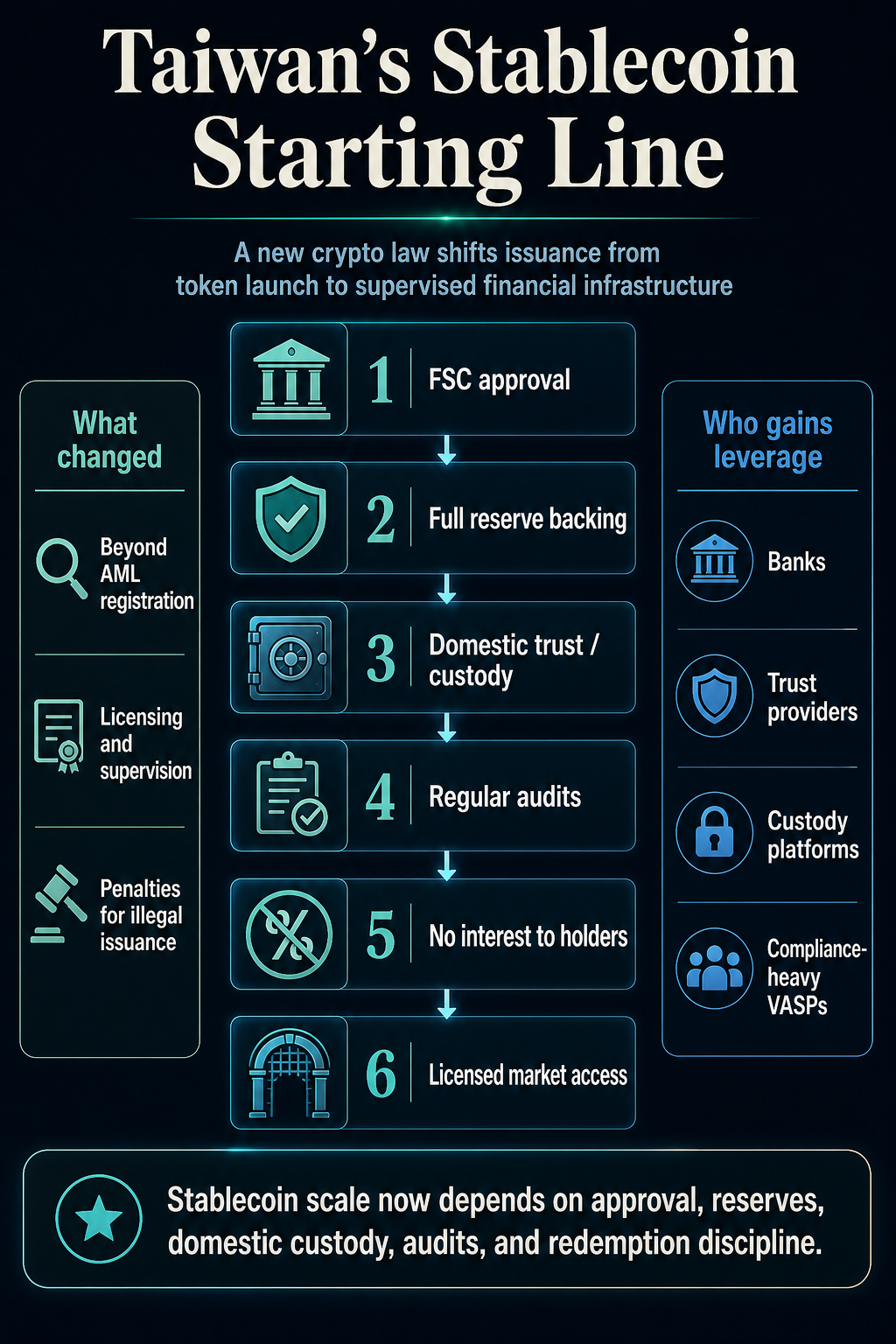
From AML registration to stablecoin supervision
Taiwan already had an in-force anti-money laundering registration regime for virtual asset service providers. CryptoSlate’s prior profile of the Taiwan VASP AML Registration Regime treated that system as an AML and counter-terrorist financing framework.
The new act moves beyond that baseline. The Executive Yuan’s April draft context described the bill as a comprehensive framework for VASPs and stablecoin issuers, aimed at financial soundness, segregated custody, unfair trading controls, and market stability.
The passage report says VASPs will need approval from the Financial Supervisory Commission before operating, along with internal controls, cybersecurity, and business continuity requirements.
AML registration asks whether a firm has met baseline controls to operate in a monitored sector. A licensing and supervisory framework asks whether the business model, capital structure, customer protection setup, and operating systems are sufficient to be permitted in the market.

For stablecoins, the difference is sharper. A crypto issuer can normally present a stablecoin as a product. Taiwan’s law treats domestic issuance as a supervised activity linked to reserve quality, custody location, audits and financial stability.
That pulls the product away from pure crypto distribution and closer to the regulated plumbing of payments.
Existing VASPs that completed AML registration before the law takes effect will have 12 months to apply for licenses and 21 months to obtain approval, according to the passage report.
The timing should be tied to the law’s effective date and the next layer of rules, which still need to be set by the government.
The stablecoin provisions decide who can plausibly compete. Focus Taiwan reported that issuers will need full reserve backing, with segregated assets held in trust by domestic financial institutions.
It also reported that those reserve assets are protected from other creditor claims if an issuer enters bankruptcy, and that issuers must undergo regular audits while being barred from paying interest or other returns to holders.
Those mechanics do two things at once. They make stablecoins safer for users by tying issuance to identifiable reserves and domestic trust arrangements. They also raise the operational bar.
An issuer must be able to manage reserve assets, prove segregation, satisfy audit expectations, handle redemption obligations, and work with domestic financial institutions before it can scale.
That is where the bank-supervised race begins. The current public record leaves room for nonbank issuers, while making domestic financial institutions central to how reserves are held and protected.
That gives banks, trust companies and regulated custody partners a structural role before any nonbank crypto issuer can reach meaningful domestic adoption.
Legal-market analysis from Lee and Li, published by Chambers and Partners before passage, also pointed to FSC approval with central bank consultation, local financial-institution reserves, reserve separation, regular audits, possible additional reserves above a certain issuance scale and central bank foreign-exchange rules.
That context supports the same practical conclusion: the market will likely be shaped by financial institutions and compliance infrastructure even if secondary rules leave room for nonbank applicants.
The no-yield rule is equally important. If holders cannot receive interest or other returns from the stablecoin, the issuer’s pitch must be built around access, redemption, trust, settlement, and compliance.
That favors payment infrastructure, custody relationships and regulated settlement over the growth tactics that helped many crypto products attract users during high-yield cycles.
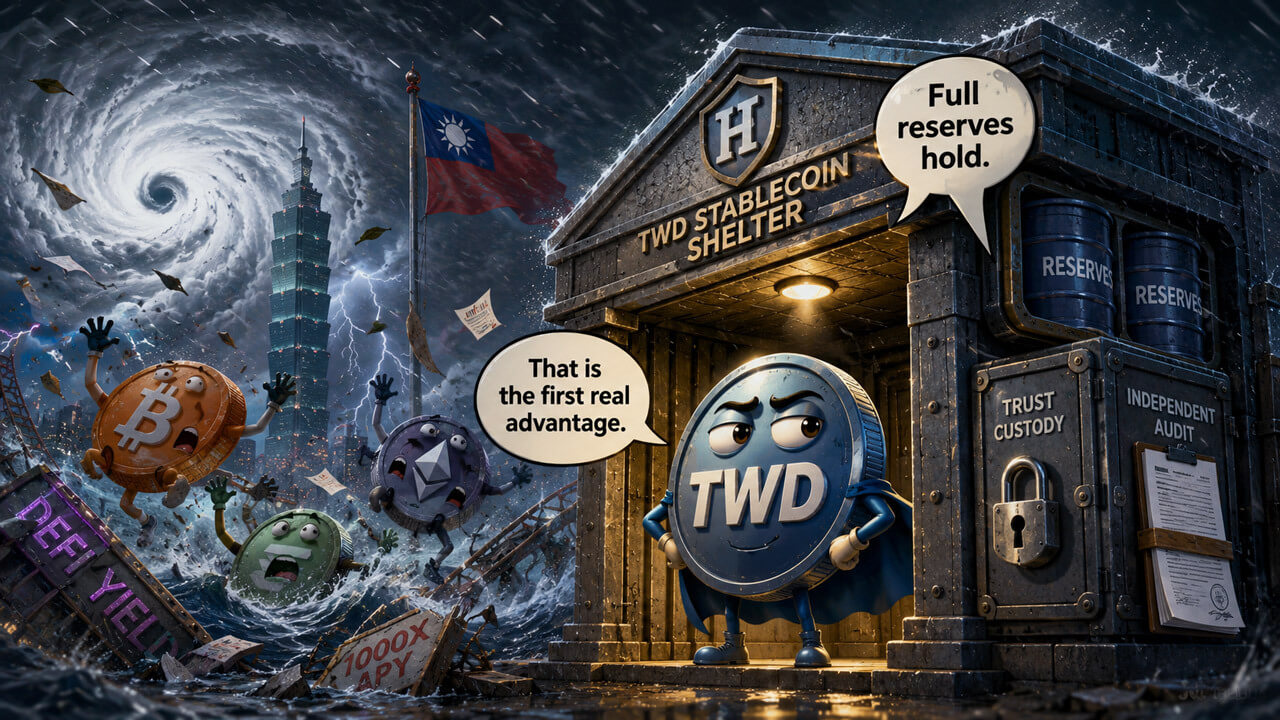
Why Taiwan’s rulebook travels
Taiwan is not trying to become the largest stablecoin market overnight. The significance is that stablecoins have become one of crypto’s main liquidity rails, and domestic regulators are deciding who can issue, custody, and redeem them within their borders.
CryptoSlate market pages showed the stablecoin sector at about $292.38 billion, with USDT and USDC accounting for most of the category by dominance.
That scale gives Taiwan’s rulebook weight without turning the story into a sweeping global comparison. Stablecoins are already large enough that local rules decide whether domestic payment rails connect to offshore liquidity, bank custody, licensed platforms or some combination of all three.
Taiwan’s earlier policy direction also points toward a financial-infrastructure model. CryptoSlate previously covered Taiwan’s path for bank-issued stablecoins and its digital asset custody pilot for banks.

The new law turns those setup pieces into a broader market question: whether licensed crypto firms can compete on their own or will need bank and trust relationships to offer stablecoin services that regulators will approve.
The answer is likely mixed. Banks may not need to dominate issuance to dominate the infrastructure around it.
Custody, reserve management, audits, redemption channels, and regulatory reporting can all become gatekeeping functions. Nonbank issuers may still compete, but the competition begins only after they prove they can operate within that financial-control stack.
The next test is in secondary rules. Taiwan still needs an effective date.
The FSC and other authorities still need to define secondary rules covering issuer eligibility, reserve composition, disclosures, redemption procedures and the treatment of stablecoins already used by traders but not authorized for domestic issuance or trading services.
Taiwan has not handed stablecoin issuance to banks. It has created a regime in which scale depends on approval, full reserves, domestic trust or custody, audits and a no-yield design.
In practice, that makes bank-supervised infrastructure the starting line.
Penalties reinforce the shift. Illegal VASP operations or stablecoin issuance can result in up to 7 years in prison and a fine of up to NT$100 million, while fraud or market manipulation can result in 3 to 10 years in prison and fines ranging from NT$10 million to NT$200 million.
The law is an enforceable perimeter around who can operate, issue, and market crypto services in Taiwan.
The next signal is the detail of the licensing rules. If the FSC creates a path that allows nonbank issuers to satisfy the same reserve, custody, and audit obligations directly, Taiwan could still have a competitive domestic stablecoin market.
If the practical route runs through banks, trust structures, and supervised custody partners, then the law will have turned stablecoin issuance into a race that crypto-native issuers can enter only after financial institutions have laid the rails.












-

 De-fi3 days ago
How the “buy, borrow, die” tax trade is quietly loading DeFi pools with hidden credit risk – Crypto News
-

 Technology3 days ago
While Big Tech chased AI, Apple built something else – Its biggest product wave yet | What’s coming in 2026 and beyond – Crypto News
-

 Cryptocurrency1 day ago
OpenAI’s GPT-6 Astra Is Shockingly Good at Almost Everything – Crypto News