

Cryptocurrency
Why Binance’s reported $2B Mesh investment could decide who controls stablecoin payments – Crypto News

Binance’s reported move to lead a new Mesh funding round puts a strategic price on the payment routes stablecoins need to leave exchanges, wallets, and trading venues.
A July 2 Axios Pro report said Binance is set to lead a Mesh round valuing the crypto payments company at up to $2 billion. Mesh announced in January that it had closed a $75 million Series C at a $1 billion valuation, so the reported terms would mark a rapid step-up for a company building payment infrastructure rather than another token issuer.
The signal sits in where the reported capital would land. An exchange with users, wallets, liquidity, and merchant payment ambitions would move closer to the layer that determines how stablecoin payments travel from wallets and trading venues to merchants, payment providers, and fiat accounts.
If the round closes on the reported terms, it would point to a new phase in stablecoin competition. The early race centered on issuers, reserves, regulatory status, and market share. The next phase is more operational: who controls the routes that make tokenized dollars spendable off-screen.

Stablecoins already have scale. CryptoSlate’s stablecoin sector page showed a market cap of about $292 billion and a 24-hour trading volume of $95.6 billion on July 3, 2026. CryptoSlate’s coin rankings showed USDT and USDC together accounting for roughly $257 billion in market cap and about $845 billion in 24-hour trading volume.
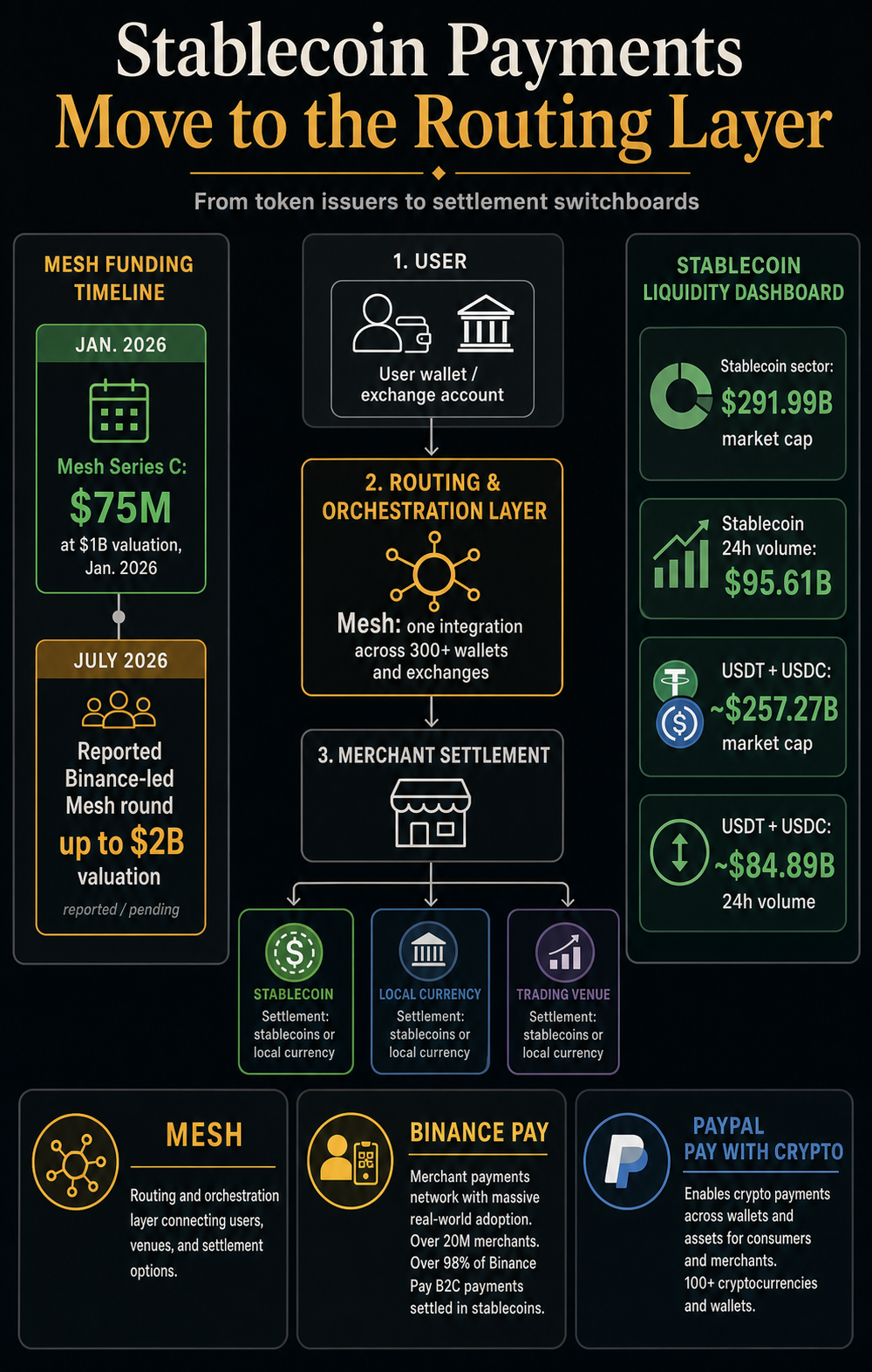
That liquidity still has to be converted into a payment flow. A consumer may hold funds at an exchange, in a self-custody wallet, in a fintech app, or on a chain a merchant may prefer to avoid handling directly. A merchant may want local currency, a stablecoin balance, or a back-end settlement route that avoids direct integration with every wallet, chain, and compliance surface.
Why the route is becoming the prize
Mesh is trying to sit in that gap. The company positions itself as a global crypto payments network across payments, deposits, verification, payouts, stablecoin settlement, on- and off-ramps, and wallet or exchange use cases. Its payments product says merchants can use a single integration across 300+ wallets and exchanges, while customers pay from their existing accounts and merchants settle in stablecoins or local currency.
That mechanism explains the Binance signal. Stablecoin adoption depends on whether a payment can start where the user already holds money and end in the format the merchant can use. The issuer remains crucial because reserve quality, redemption access, regulatory treatment, and liquidity still determine whether a payment asset is trusted.
The transaction layer adds a separate source of leverage: which wallets are supported, which exchange account can be used, which chain carries settlement, whether conversion happens before or after checkout, and who keeps the customer relationship.
Mesh-style infrastructure turns those decisions into a product surface. Mesh’s Alliance Program describes an interoperable payments ecosystem across wallets, exchanges, blockchains, stablecoin issuers, and platforms. Its MAP page presents the idea as a partner network rather than a single closed app.
For merchants, that abstraction can reduce the number of crypto integrations they need to support. For wallets and exchanges, it can convert account balances into spendable funds without requiring users to withdraw, bridge, or manually select settlement paths. For stablecoin issuers, it can expand usage, while leaving distribution partly shaped by platforms that sit between the issuer and the payment.
| Layer | What it connects | Strategic role |
|---|---|---|
| Mesh | 300+ wallets and exchanges, with stablecoin or local-currency merchant settlement | Turns fragmented crypto balances into a checkout and settlement route |
| Binance Pay | Exchange users, merchants, and stablecoin-settled B2C payments | Shows why an exchange benefits when account balances become payment balances |
| PayPal Pay with Crypto | U.S. merchants, 100 cryptocurrencies, and wallet connections including Coinbase, OKX, Binance, Kraken, Phantom, MetaMask, and Exodus | Shows mainstream payment firms can own the merchant-facing experience while crypto payment infrastructure handles wallet-to-merchant routing |
The comparison captures the market shift. Stablecoin payments are moving beyond a contest over the largest supply of digital dollars. The competitive edge can go to the platform that moves supply across wallets, exchanges, apps, and merchants with the least friction.

Binance’s reported interest in Mesh is easier to understand when viewed alongside Binance Pay. In a November blog post, Binance said Binance Pay had over 20 million merchants and that over 98% of Binance Pay B2C payments in 2025 so far were settled in stablecoins.
Those figures make payments a distribution surface. An exchange that already has users, liquidity, wallets, and merchant payment ambitions has a reason to care about infrastructure that connects those balances to outside commerce.
The strategic value goes beyond processing one more transaction. It keeps the user’s starting point within the exchange account while making that balance useful beyond the exchange’s direct merchant relationships. If a routing network can connect exchange balances, wallets, stablecoins, and fiat settlement in one flow, it can extend the exchange’s reach without requiring every merchant to become a crypto infrastructure operator.
What would make the layer valuable?
Other payment companies are chasing the same account-to-merchant path. PayPal said Pay with Crypto would be available to U.S. merchants and would allow payments in 100 cryptocurrencies, including BTC, ETH, USDT, XRP, BNB, Solana, and USDC, while connecting wallets such as Coinbase, OKX, Binance, Kraken, Phantom, MetaMask, and Exodus.
PayPal approaches the market from a different starting point than Binance, but the direction is similar. PayPal starts with a mainstream merchant network and payment brand. Binance starts with exchange liquidity, crypto-native users, and Binance Pay. Mesh starts with the integration and orchestration layer.
All three point to the same market structure: stablecoin payments gain commercial traction when the holder, wallet, exchange, processor, and merchant no longer need to coordinate the route manually.
The policy backdrop makes that fight more visible. The White House said the GENIUS Act provides for the regulation of payment stablecoins, while EY later described stablecoin adoption as driven by cost savings and speed, with surveyed institutions and corporates beginning to use or plan for the technology.

Once regulation and liquidity make stablecoins more acceptable, the hard commercial question shifts to distribution. Who gets stablecoins in front of users at checkout? Who decides which stablecoin is converted, settled, or held? Who earns economics from routing and conversion? And who owns the data trail that shows where tokenized money is actually being used?
CryptoSlate has already tracked stablecoins moving into payment rails and partner-led distribution, including the way card networks, processors, and exchange-linked products are rebuilding parts of the payment stack. A reported Binance-led Mesh round would add an exchange-centered take on the same theme: trading venues are moving before stablecoin payments are handed entirely over to traditional processors.
The open question is defensibility. Routing infrastructure is valuable when merchants, exchanges, wallets, and payment providers treat it as a trusted, neutral layer that simplifies integration. It loses force if the largest platforms replicate the same connections internally or if partners worry that a routing network creates a new control point.
That is why the reported Binance role deserves attention with precise caveats. Axios supplies a reported lead role and a valuation of up to $2 billion; the current public record still leaves open whether the round has closed, whether Binance would receive privileged routing, or whether Mesh’s partner network would change its neutrality.
The next signal is therefore commercial as much as financial: more exchanges, wallets, payment service providers, and merchants choosing a shared orchestration layer instead of building direct bilateral connections. If that happens, the stablecoin land grab moves up the stack. Issuers will still fight over supply, but exchanges and wallets will fight over the routes that decide where tokenized money can actually be spent.