


others
Canadian Dollar gets knocked down by Greenback after hot US PPI inflation on Thursday – Crypto News

- Canadian Dollar gains against everything except the US Dollar.
- Canadian Manufacturing Sales barely register on the radar.
- Friday’s US UoM Consumer Sentiment in the barrel.
The Canadian Dollar (CAD) is broadly higher on Friday, landing in the green against the majority of its major currency peers but still shedding over half of a percent against the US Dollar (USD) bottom-to-top. Markets piled back into the Greenback bid after US Retail Sales missed the mark on Thursday, and the US Producer Price Index (PPI) stubbornly refused to give up ground.
Canada brought an update to January’s MoM Manufacturing Sales that barely registered in markets as investors focused squarely on US data and its impact on Federal Reserve (Fed) rate cut bets. On Thursday, following the US data dump, rate futures repriced slightly lower odds of a June rate trim from the Fed.
Daily digest market movers: US data kicks rate cut bets further back, US Dollar bids higher
- US Retail Sales in February missed expectations, rebounding to 0.6% MoM versus the forecast of 0.8%. However, this is still recovered from the previous -1.1% decline (revised lower from -0.8%).
- February’s US PPI showed producer-level inflation remains on the warm side, with YoY PPI holding steady at 2.0% instead of easing to 1.9% as markets expected.
- MoM US PPI eased to 0.3% from the previous 0.5% but failed to meet the market’s expected 0.2%.
- US Initial Jobless Claims also came in healthier than expected, with 209K new jobless benefits seekers for the week ended March 8 versus the forecast 218K. The previous week’s benefit seekers was also revised to 210K from 217K.
- The four-week average for Initial Jobless claims has dipped to 208K as the US labor market remains too tight to allow the Fed to cut rates as quickly and easily as markets were hoping for.
- Canadian Manufacturing Sales rebounded to 0.2% in January, missing the forecast 0.4% but still recovering from the previous month’s -1.1% decline (revised down from -0.7%).
Canadian Dollar price today
The table below shows the percentage change of Canadian Dollar (CAD) against listed major currencies today. Canadian Dollar was the strongest against the Australian Dollar.
| USD | EUR | GBP | CAD | AUD | JPY | NZD | CHF | |
| USD | 0.60% | 0.39% | 0.39% | 0.64% | 0.38% | 0.49% | 0.53% | |
| EUR | -0.61% | -0.22% | -0.23% | 0.03% | -0.23% | -0.13% | -0.08% | |
| GBP | -0.40% | 0.21% | -0.02% | 0.23% | -0.04% | 0.07% | 0.12% | |
| CAD | -0.39% | 0.24% | 0.03% | 0.26% | 0.00% | 0.10% | 0.15% | |
| AUD | -0.64% | -0.06% | -0.25% | -0.24% | -0.27% | -0.15% | -0.09% | |
| JPY | -0.38% | 0.24% | 0.03% | 0.00% | 0.29% | 0.12% | 0.16% | |
| NZD | -0.47% | 0.14% | -0.07% | -0.08% | 0.16% | -0.10% | 0.08% | |
| CHF | -0.52% | 0.08% | -0.12% | -0.14% | 0.13% | -0.14% | -0.04% |
The heat map shows percentage changes of major currencies against each other. The base currency is picked from the left column, while the quote currency is picked from the top row. For example, if you pick the Euro from the left column and move along the horizontal line to the Japanese Yen, the percentage change displayed in the box will represent EUR (base)/JPY (quote).
Technical analysis: Canadian Dollar broadly higher, but Greenback takes top spot on Thursday
The Canadian Dollar (CAD) is in the green against nearly all of its major currency peers, climbing a fifth of a percent against the Euro (EUR) and the Australian Dollar (AUD). The CAD is holding close to flat against the Japanese Yen (JPY) as the two battle for second place on Thursday, with the US Dollar the clear winner on the currency board. The Canadian Dollar is currently down around a third of a percent against the USD.
The USD/CAD rallied back over the 1.3500 handle as markets dog-piled back into the US Dollar, driving the pair into a fresh high for the week above 1.3530 and sending bids into battle with the 200-hour Simple Moving Average (SMA) near 1.3508. 1.3460 is the new intraday support level for sellers to beat, while a strong continuation into the top side will see a heavy supply zone near the 1.3600 handle.
Despite near-term gains, USD/CAD continues to wrestle with the 200-day SMA at 1.3480, cycling both sides of the major moving average for six straight trading days. The pair has consolidated around the 200-day SMA since rising into the 1.3500 neighborhood in January after a recovery from late December’s swing low below 1.3200.
USD/CAD hourly chart
USD/CAD daily chart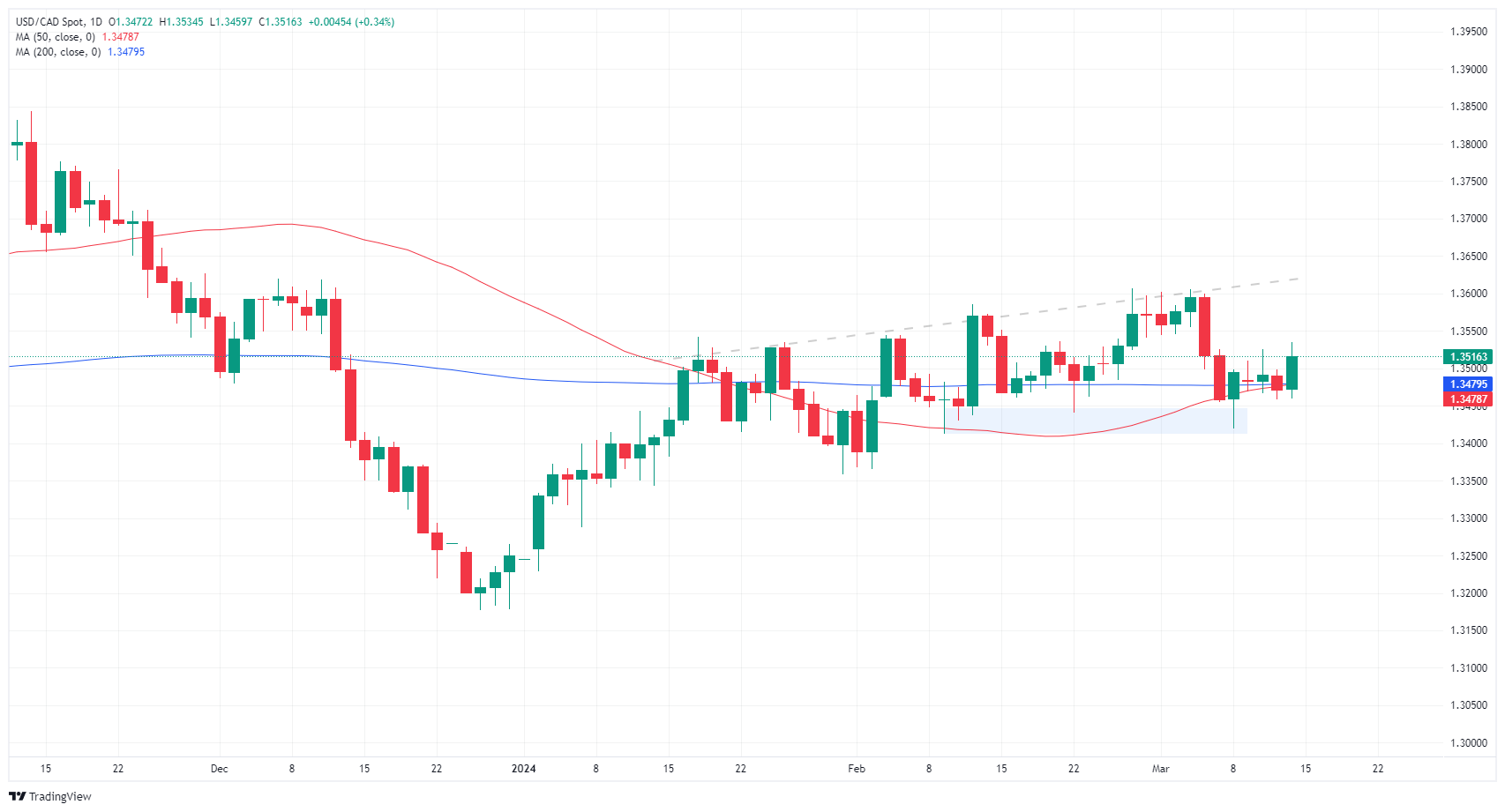
Canadian Dollar FAQs
The key factors driving the Canadian Dollar (CAD) are the level of interest rates set by the Bank of Canada (BoC), the price of Oil, Canada’s largest export, the health of its economy, inflation and the Trade Balance, which is the difference between the value of Canada’s exports versus its imports. Other factors include market sentiment – whether investors are taking on more risky assets (risk-on) or seeking safe-havens (risk-off) – with risk-on being CAD-positive. As its largest trading partner, the health of the US economy is also a key factor influencing the Canadian Dollar.
The Bank of Canada (BoC) has a significant influence on the Canadian Dollar by setting the level of interest rates that banks can lend to one another. This influences the level of interest rates for everyone. The main goal of the BoC is to maintain inflation at 1-3% by adjusting interest rates up or down. Relatively higher interest rates tend to be positive for the CAD. The Bank of Canada can also use quantitative easing and tightening to influence credit conditions, with the former CAD-negative and the latter CAD-positive.
The price of Oil is a key factor impacting the value of the Canadian Dollar. Petroleum is Canada’s biggest export, so Oil price tends to have an immediate impact on the CAD value. Generally, if Oil price rises CAD also goes up, as aggregate demand for the currency increases. The opposite is the case if the price of Oil falls. Higher Oil prices also tend to result in a greater likelihood of a positive Trade Balance, which is also supportive of the CAD.
While inflation had always traditionally been thought of as a negative factor for a currency since it lowers the value of money, the opposite has actually been the case in modern times with the relaxation of cross-border capital controls. Higher inflation tends to lead central banks to put up interest rates which attracts more capital inflows from global investors seeking a lucrative place to keep their money. This increases demand for the local currency, which in Canada’s case is the Canadian Dollar.
Macroeconomic data releases gauge the health of the economy and can have an impact on the Canadian Dollar. Indicators such as GDP, Manufacturing and Services PMIs, employment, and consumer sentiment surveys can all influence the direction of the CAD. A strong economy is good for the Canadian Dollar. Not only does it attract more foreign investment but it may encourage the Bank of Canada to put up interest rates, leading to a stronger currency. If economic data is weak, however, the CAD is likely to fall.
Inflation FAQs
Inflation measures the rise in the price of a representative basket of goods and services. Headline inflation is usually expressed as a percentage change on a month-on-month (MoM) and year-on-year (YoY) basis. Core inflation excludes more volatile elements such as food and fuel which can fluctuate because of geopolitical and seasonal factors. Core inflation is the figure economists focus on and is the level targeted by central banks, which are mandated to keep inflation at a manageable level, usually around 2%.
The Consumer Price Index (CPI) measures the change in prices of a basket of goods and services over a period of time. It is usually expressed as a percentage change on a month-on-month (MoM) and year-on-year (YoY) basis. Core CPI is the figure targeted by central banks as it excludes volatile food and fuel inputs. When Core CPI rises above 2% it usually results in higher interest rates and vice versa when it falls below 2%. Since higher interest rates are positive for a currency, higher inflation usually results in a stronger currency. The opposite is true when inflation falls.
Although it may seem counter-intuitive, high inflation in a country pushes up the value of its currency and vice versa for lower inflation. This is because the central bank will normally raise interest rates to combat the higher inflation, which attract more global capital inflows from investors looking for a lucrative place to park their money.
Formerly, Gold was the asset investors turned to in times of high inflation because it preserved its value, and whilst investors will often still buy Gold for its safe-haven properties in times of extreme market turmoil, this is not the case most of the time. This is because when inflation is high, central banks will put up interest rates to combat it. Higher interest rates are negative for Gold because they increase the opportunity-cost of holding Gold vis-a-vis an interest-bearing asset or placing the money in a cash deposit account. On the flipside, lower inflation tends to be positive for Gold as it brings interest rates down, making the bright metal a more viable investment alternative.






-

 Blockchain1 week ago
US Sanctions Iran-Linked HormuzSafe, Cites Bitcoin Payments – Crypto News
-

 De-fi1 week ago
Bitcoin Slips Below $64K After Warsh Says “No Soft Inflation Target” – Crypto News
-

 Cryptocurrency1 week ago
Three key demand drivers stall at once, leaving Bitcoin’s $64,000 support to long-term holders – Crypto News
-

 Cryptocurrency1 week ago
Twenty One Capital’s new CEO warns the Bitcoin treasury playbook is dying – Crypto News
-

 Blockchain1 week ago
Elliptic Report Shows How Bitcoin ATM Scams Move From Cash To On-Chain Wallets – Crypto News
-

 Technology1 week ago
AI to strengthen enterprise software firms, not replace them: Goldman Sachs – Crypto News
-
Technology1 week ago
Breaking: Ripple-Backed XRP Treasury Evernorth Files S-4, Finalizes Executive Agreements – Crypto News
-
others1 week ago
Pi Network Price Prediction as PI Outperforms Bitcoin Ahead of Ninth Protocol Upgrade – Crypto News
-

 Blockchain1 week ago
zerohash Launches Agentic Finance Tools for Platforms – Crypto News
-

 Cryptocurrency1 week ago
Forget ETF flows, Bitcoin’s real threat is a hidden $39,900 liquidation wall – Crypto News
-

 De-fi1 week ago
SEC warning over crypto yield vaults puts DeFi’s secret human controllers in the crosshairs – Crypto News
-
Technology1 week ago
AI to strengthen enterprise software firms, not replace them: Goldman Sachs – Crypto News
-
others1 week ago
Breaking: Senator Tillis Pushes to Send Clarity Act Ethics Package to White House by Friday – Crypto News
-

 Cryptocurrency4 days ago
Washington gave crypto every legal win it begged for then lost the market anyway – Crypto News
-
Business1 week ago
US Senators Give Apple Aug 21 Deadline to Dump Blacklisted Chinese Chipmakers CXMT & YMTC – Crypto News