others
Canadian Dollar rebounds on Thursday but remains lower against Greenback – Crypto News

- Canadian Dollar grapples with recovering US Dollar.
- Canada remains absent from the economic calendar on Thursday.
- CAD traders looking ahead to next Tuesday’s Canadian CPI inflation.
The Canadian Dollar (CAD) is broadly higher on Thursday, gaining ground across the board but still struggling under the weight of the US Dollar (USD) as the Greenback recovers from the previous day’s plunge. Mid-tier data had a limited impact, and Fedspeak is expected to dominate the headlines.
Canada delivered no economic data on Thursday and is expected to remain absent or strictly low-tier until next week’s Consumer Price Index (CPI) inflation release slated for next Tuesday. US data carried few surprises, with housing starts and new unemployment claims missing forecasts, but only by slim margins.
Daily market movers: Canadian Dollar battles Greenback as US data, Fedspeak dominate
- US Initial Jobless Claims eased to 222K for the week ended May 10, stepping back from the previous week’s 232K (revised from 231K) but still undershot the 220K forecast.
- US Housing Starts in April rose to 1.36 million MoM, above the previous 1.287 million (revised from 1.321 million) but below the forecast of 1.48 million.
- Talking points from Fed policymakers to dominate the financial news cycle until higher-impact data approaches.
- Federal Reserve Bank of Cleveland President Loretta J. Mester on Thursday:
- I welcome recent CPI data as a sign of cooling inflation.
- It will still take longer to gain confidence that inflation is moving toward 2%.
- Risks to inflation side of Fed’s mandate have increased.
- A strong economy means Fed is risking little to hold policy in place.
Technical analysis: Canadian Dollar finds thin gains, but Greenback weighs
The Canadian Dollar (CAD) is broadly higher on Thursday but still struggling to make meaningful gains against the US Dollar. The CAD is up over half a percent against the Japanese Yen (JPY) and a third of a percent against the Swiss Franc (CHF). On the low side, the Canadian Dollar is weaker by about a tenth of a percent against the USD.
USD/CAD continues to churn near the 1.3600 handle as technicals swamp the pair near a familiar demand zone from 1.3660. The pair remains on the low side of the 200-hour Exponential Moving Average (EMA) at 1.3664. The Canadian Dollar tested a four-week high against the US Dollar on Thursday, dragging the USD/CAD pair down to 1.3590 before USD bids recovered into positive territory.
Despite slim topside gains for the Greenback, USD/CAD is battling near-term bearishness, trading south of the 50-day EMA at 1.3637. The pair is down -1.7% from the last swing high above 1.3840.
USD/CAD hourly chart
USD/CAD daily chart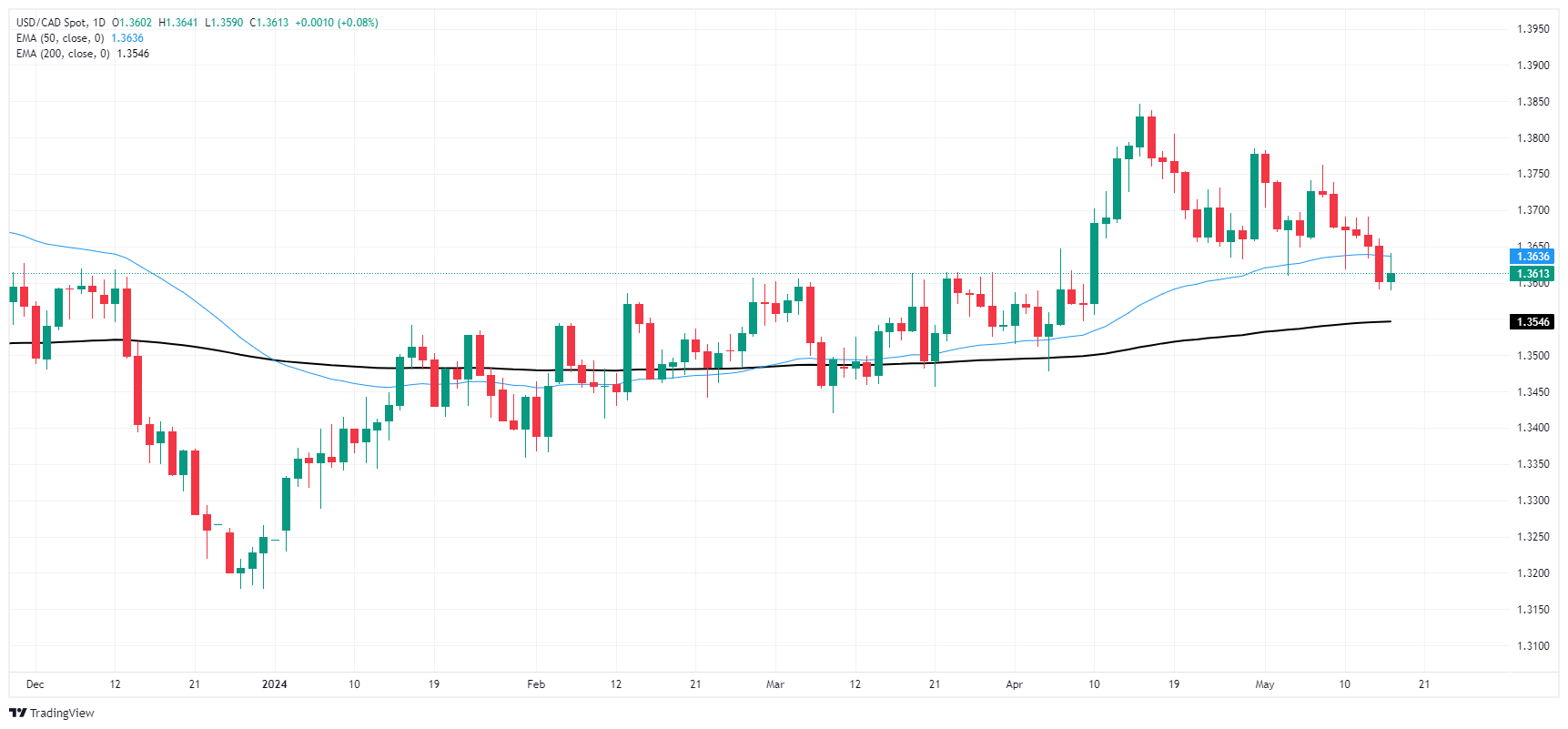
Canadian Dollar FAQs
The key factors driving the Canadian Dollar (CAD) are the level of interest rates set by the Bank of Canada (BoC), the price of Oil, Canada’s largest export, the health of its economy, inflation and the Trade Balance, which is the difference between the value of Canada’s exports versus its imports. Other factors include market sentiment – whether investors are taking on more risky assets (risk-on) or seeking safe-havens (risk-off) – with risk-on being CAD-positive. As its largest trading partner, the health of the US economy is also a key factor influencing the Canadian Dollar.
The Bank of Canada (BoC) has a significant influence on the Canadian Dollar by setting the level of interest rates that banks can lend to one another. This influences the level of interest rates for everyone. The main goal of the BoC is to maintain inflation at 1-3% by adjusting interest rates up or down. Relatively higher interest rates tend to be positive for the CAD. The Bank of Canada can also use quantitative easing and tightening to influence credit conditions, with the former CAD-negative and the latter CAD-positive.
The price of Oil is a key factor impacting the value of the Canadian Dollar. Petroleum is Canada’s biggest export, so Oil price tends to have an immediate impact on the CAD value. Generally, if Oil price rises CAD also goes up, as aggregate demand for the currency increases. The opposite is the case if the price of Oil falls. Higher Oil prices also tend to result in a greater likelihood of a positive Trade Balance, which is also supportive of the CAD.
While inflation had always traditionally been thought of as a negative factor for a currency since it lowers the value of money, the opposite has actually been the case in modern times with the relaxation of cross-border capital controls. Higher inflation tends to lead central banks to put up interest rates which attracts more capital inflows from global investors seeking a lucrative place to keep their money. This increases demand for the local currency, which in Canada’s case is the Canadian Dollar.
Macroeconomic data releases gauge the health of the economy and can have an impact on the Canadian Dollar. Indicators such as GDP, Manufacturing and Services PMIs, employment, and consumer sentiment surveys can all influence the direction of the CAD. A strong economy is good for the Canadian Dollar. Not only does it attract more foreign investment but it may encourage the Bank of Canada to put up interest rates, leading to a stronger currency. If economic data is weak, however, the CAD is likely to fall.