others
Euro looks for further gains on Wednesday, but plenty of roadblocks remain – Crypto News

- The Euro is broadly higher on Wednesday, gaining ground across the board.
- ECB’s de Guindos noted that the Eurozone could be in a technical recession.
- Still-firm Unemployment Rate bolstering Euro even as it swamps out ECB rate cut hopes.
The Euro (EUR) saw thin but insistent broad-market gains on Wednesday, climbing against the rest of the major currency bloc in thin markets on equally thin data, with Tuesday’s Eurozone Unemployment Rate continuing to bolster the Euro as investors shrug off bearishly cautionary statements from European Central Bank (ECB) policymakers.
Europe saw its November Unemployment Rate tick lower on Tuesday, helping to prop up the Euro through the first half of the trading week, and despite the broad expanse of economic activity figures largely coming in at contractionary levels, key data continues to print better than initial investor expectations.
Daily digest market movers: Euro buoyed by not-bad-enough datapoints, ECB warnings sail passed Euro
- Euro outperforms the rest of the major currency market, in the green across the board for Wednesday and the week overall.
- European Unemployment Rate ticked down to 6.4% in November from October’s 6.5%, bolstering the EUR even as it weighs on ECB rate cut hopes and European equities.
- European equities softened on Wednesday as risk appetite wanes
- ECB Vice President de Guindos noted that Europe was likely in a technical recession in 2023’s fourth quarter as growth continues to disappoint.
- Head of Spain’s central bank Banco de España (BdE) and ECB Governing Council Member Pablo Hernandez de Cos struck a balancing tone against de Guindos’ bearish outlook.
- De Cos: “In addition to geopolitical developments, the transmission of monetary policy has been surprising us for its strength, which, if extended in the coming years, would translate into lower growth.”
- ECB’s de Guindos: Rapid pace of disinflation likely to slow down in 2024.
- The Euro sees one more speech from ECB Chief Economist Philip Lane before investors turn towards next week’s final Eurozone Consumer Price Index (CPI) figures, slated for next Wednesday.
Euro price today
The table below shows the percentage change of Euro (EUR) against listed major currencies today. Euro was the strongest against the Japanese Yen.
| USD | EUR | GBP | CAD | AUD | JPY | NZD | CHF | |
| USD | -0.32% | -0.20% | -0.08% | -0.23% | 0.86% | 0.30% | -0.11% | |
| EUR | 0.31% | 0.11% | 0.23% | 0.09% | 1.17% | 0.60% | 0.22% | |
| GBP | 0.19% | -0.12% | 0.11% | -0.02% | 1.05% | 0.49% | 0.10% | |
| CAD | 0.07% | -0.23% | -0.11% | -0.12% | 0.95% | 0.38% | 0.01% | |
| AUD | 0.21% | -0.12% | 0.00% | 0.12% | 1.06% | 0.49% | 0.10% | |
| JPY | -0.87% | -1.19% | -1.07% | -0.96% | -1.09% | -0.58% | -0.97% | |
| NZD | -0.30% | -0.62% | -0.50% | -0.38% | -0.51% | 0.53% | -0.44% | |
| CHF | 0.07% | -0.23% | -0.11% | 0.01% | -0.12% | 0.94% | 0.39% |
The heat map shows percentage changes of major currencies against each other. The base currency is picked from the left column, while the quote currency is picked from the top row. For example, if you pick the Euro from the left column and move along the horizontal line to the Japanese Yen, the percentage change displayed in the box will represent EUR (base)/JPY (quote).
Technical Analysis: Despite stubborn topside momentum, significant headwinds remain for the Euro
The Euro is rising to claim top spot of the major currency bloc on Wednesday, in the green against its major counterparts on the day and also on the week thus far. The Euro has gained a third of a percent against the US Dollar (USD) on Wednesday, and is up around 1.2% against the beleaguered Japanese Yen (JPY), while climbing six-tenths of a percent against the New Zealand Dollar (NZD) and a fifth of a percent against the Canadian Dollar (CAD).
Despite bullish intraday momentum, the EUR/USD is set for a near-term rejection of the 200-hour Simple Moving Average (SMA), running into a technical ceiling at the top of a recent sideways channel forming on intraday charts between 1.0970 and 1.0910.
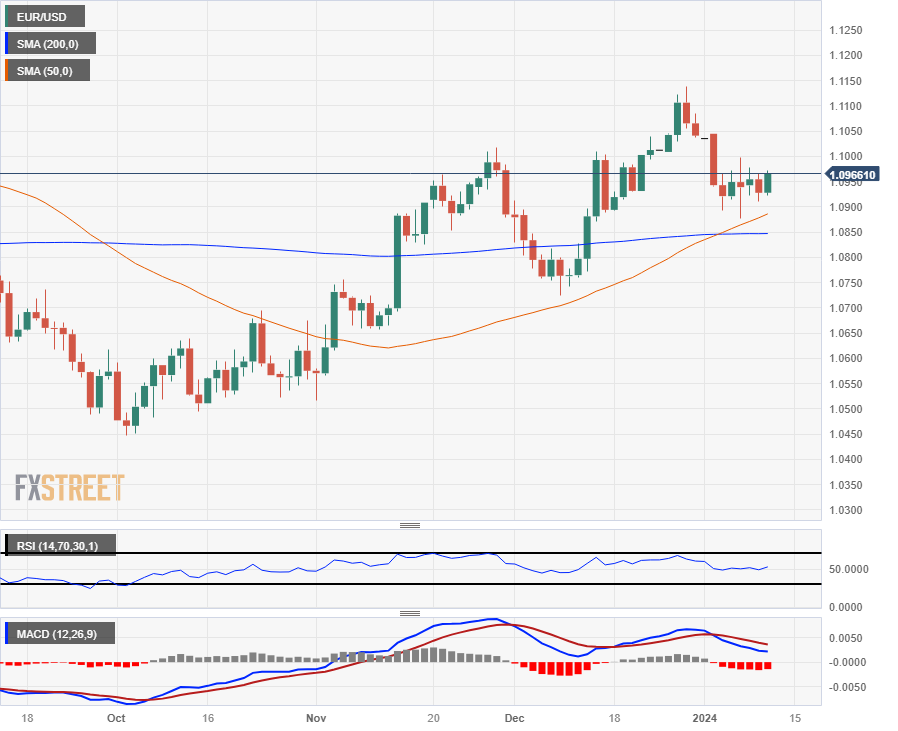
Despite intraday headwinds, the EUR/USD looks well-supported on daily candlesticks, with the pair trading just north of a bullish crossover of the 50-day and 200-day SMAs near 1.0850, though a bearish pullback into the 1.0800 handle will see the pair set for a fresh run into 2023’s low bids below 1.0500.
EUR/USD Hourly Chart
EUR/USD Daily Chart
ECB FAQs
The European Central Bank (ECB) in Frankfurt, Germany, is the reserve bank for the Eurozone. The ECB sets interest rates and manages monetary policy for the region.
The ECB primary mandate is to maintain price stability, which means keeping inflation at around 2%. Its primary tool for achieving this is by raising or lowering interest rates. Relatively high interest rates will usually result in a stronger Euro and vice versa.
The ECB Governing Council makes monetary policy decisions at meetings held eight times a year. Decisions are made by heads of the Eurozone national banks and six permanent members, including the President of the ECB, Christine Lagarde.
In extreme situations, the European Central Bank can enact a policy tool called Quantitative Easing. QE is the process by which the ECB prints Euros and uses them to buy assets – usually government or corporate bonds – from banks and other financial institutions. QE usually results in a weaker Euro.
QE is a last resort when simply lowering interest rates is unlikely to achieve the objective of price stability. The ECB used it during the Great Financial Crisis in 2009-11, in 2015 when inflation remained stubbornly low, as well as during the covid pandemic.
Quantitative tightening (QT) is the reverse of QE. It is undertaken after QE when an economic recovery is underway and inflation starts rising. Whilst in QE the European Central Bank (ECB) purchases government and corporate bonds from financial institutions to provide them with liquidity, in QT the ECB stops buying more bonds, and stops reinvesting the principal maturing on the bonds it already holds. It is usually positive (or bullish) for the Euro.